Personalized Medical Care & Dedicated International Patient Concierge

Medical Guide
Skin Boosters: What Hydration and Texture Really Mean
Medically reviewed by Dr. Byun Sung Ho, MD, Director, Toxnfill Hongdae Almost every skin booster in existence is sold with the same two nouns. Hydration. Texture. They appear on th
Schedule a ConsultationMedically reviewed by Dr. Byun Sung Ho, MD, Director, Toxnfill Hongdae
Almost every skin booster in existence is sold with the same two nouns. Hydration. Texture. They appear on the menu, in the consent form, in the follow-up message asking how you are getting on. And they are close to meaningless as written, because nobody ever defines them — not the clinic, and usually not the patient either.
That vagueness is not harmless. It is the reason a treatment can be performed correctly, heal uneventfully, and still leave someone quietly disappointed four weeks later. They wanted something specific. They asked for it using a word that could have meant five different things. Nobody noticed the mismatch until the result arrived.
So this article does something unglamorous. It takes those two words apart and puts a concrete clinical target behind each of them, so that you can work out — before you book anything — whether the thing you dislike about your face is the thing this category of treatment is actually aimed at.
What You Are Describing When You Say "Dull"
Start with the complaint, not the product.
Nobody comes in saying "my stratum corneum has insufficient water content." People say their skin looks tired. Flat. Gray in photographs. Fine in the bathroom mirror and awful under the lights at work. They say their makeup used to sit and now it grips, or clings to certain areas, or slides off by mid-afternoon.
What every one of those sentences has in common is that they are descriptions of light. Skin that reads as glowing is skin that reflects light in a reasonably organized way across a smooth surface. Skin that reads as dull is scattering that light in many directions at once, because the surface is not smooth at the very small scale that light cares about. The unevenness may be far too subtle to see directly — you are not looking at the bumps, you are looking at what the bumps do to the light bouncing off them.
This is why the same face can look completely different in two rooms. Diffuse, soft light forgives an irregular surface because it arrives from many directions anyway. Hard, directional light — an overhead office fitting, a front-facing phone camera, winter sun through a window — exposes every irregularity as a tiny highlight or a tiny shadow. You have not changed. The interrogation has.
So when a clinician hears "dull," the useful translation is: something about this surface is scattering light. The next question is what. And the candidates are genuinely different from one another.
What You Are Describing When You Say "Rough"
Run a finger across your own cheekbone. Rough has at least four common causes, and they do not respond to the same things.
There is roughness from a dry, flaking outer layer, where loosely attached cells lift at the edges. There is roughness from the openings of pores, which is really a matter of the size and shadow of small holes rather than the plane of the skin around them. There is roughness from raised or depressed marks left by past inflammation, which is structural and sits deeper. And there is the fine crepe-like quality that shows up on thin skin under the eyes or on the upper cheek, which is a matter of how the skin folds when it moves.
A skin booster is not aimed at all four. It has a real claim on the first and some claim on the fourth. It has very little to say about the third, which belongs to a different kind of treatment, and only a partial and indirect relationship with the second.
This is exactly the kind of distinction that is worth an extra two minutes of consultation and is almost never made, because "texture" as a word swallows all four without complaint.
Dry Skin and Dehydrated Skin Are Not the Same Problem
Here is the single most useful distinction in this whole area, and it is genuinely under-taught.
Dryness, in the medical sense, is a deficit in the lipid side of the equation — the oily material that keeps water from escaping. StatPearls, published through the National Library of Medicine's NCBI Bookshelf, describes xeroderma as a common condition arising from inadequate hydrolipids in the skin, showing up as roughness, tightness, flaking and scaling, and it lists a broad set of drivers: age, underlying medical conditions, medications, and changes in the environment. It also notes the condition can lead to itch, scratching and a higher susceptibility to skin infection. That is a description of a barrier that is not holding.
Dehydration is a water problem rather than an oil problem, and it can happen on skin that is not remotely dry — including skin that is visibly oily. The outer layer is thirsty; the oil is fine.
Why does the difference matter so much? Because the outer layer is built for exactly this job. StatPearls' histology reference on the stratum corneum describes it as composed of corneocytes — flattened cells at the end of their working life — and explains that this layer aids hydration and water retention, which is what prevents the skin from cracking. The barrier is the reason you do not evaporate. When it is working, water stays where it should. When it is compromised, water leaves, and the surface changes both how it feels and how it reflects.
So "my skin is dehydrated" and "my skin is dry" point at different repairs. And crucially, one of them is often fixable with nothing more than a change of routine.
Why an Injected Treatment Reaches Something a Cream Cannot
Now the question that actually determines whether this category is for you.
A cream is applied to the surface, and the surface is built to keep things out. That is not a defect in the cream; it is the defining function of the layer it lands on. A well-formulated moisturizer works with that architecture rather than through it — it adds water-holding material to the outer layer and slows the rate at which water escapes. Within that remit it can be very effective, and it is cheap, reversible and under your own control.
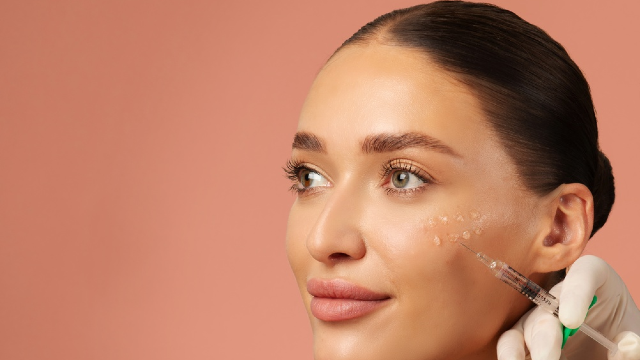
An injectable skin booster starts from a different place. Toxnfill Hongdae describes skin boosters as injectable treatments designed to support skin hydration, elasticity, texture and an overall healthy-looking appearance, considered for concerns such as dryness, fine lines, rough texture and reduced elasticity. Its Adite treatment is described as delivering a skin-nourishing solution containing materials such as hyaluronic acid, peptides or amino acids into the superficial dermis using fine micro-injections or a specialized delivery device. Its SKINVIVE option is described as an injectable hydration treatment made of modified hyaluronic acid that increases moisture within the dermal layer to refine surface smoothness and soften fine lines without adding facial volume.
Read those descriptions for what they have in common rather than for the brand names. Each one places water-attracting material below the barrier instead of on top of it, in the living tissue where the skin's own supporting material sits. That is the whole of the mechanistic argument at patient level: you are not conditioning the roof, you are changing conditions inside the house.
Two honest consequences follow. First, this is a real difference, not a marketing one — you genuinely cannot get material to that depth by rubbing it in. Second, it only matters if the problem you have is at that depth. If your complaint lives entirely in a compromised barrier, going deeper solves a problem you did not have.
Where a Good Topical Routine Does Just as Well
This is the paragraph most articles on this subject leave out, and it is where most disappointment is manufactured.
If your skin has become rough and tight over a single winter, if it flakes after cleansing, if it stings when you apply anything, if it improved noticeably the last time you happened to use a richer cream for a week — your problem is very likely a barrier problem, and a barrier problem responds to barrier care.
The American Academy of Dermatology's guidance on relieving dry skin is specific about what that looks like: limit baths and showers to five to ten minutes in warm rather than hot water, use a gentle cleanser, pat rather than rub the skin dry, apply a fragrance-free moisturizer immediately afterward and several times a day, prefer ointments and creams over lotions because they add more moisture, use a humidifier, and apply a broad-spectrum sunscreen of SPF 30 or higher along with shade and protective clothing.
None of that is glamorous and all of it works. If you have not done it properly for eight weeks, you do not yet know what your skin looks like at baseline, and an injectable treatment layered on top of an unaddressed barrier problem will underperform for reasons that have nothing to do with the injection.
The fair statement is this: topical care owns the outer layer, and it owns it well. Injectable boosters are aimed at the tissue underneath, which topicals reach poorly. A clinician who is being straight with you will say so, and will sometimes send you away with a routine instead of an appointment. At Toxnfill Hongdae, suitability for this category is determined after reviewing skin condition, medical history, allergies, medications and pregnancy status, and it is a legitimate outcome of that review that the answer is not yet.
Why This Is a Course and Not an Event
People arrive expecting an appointment. This category is closer to a program.
Toxnfill Hongdae's treatment listings make the pattern visible without any need for interpretation: its Juvelook Skin Booster is offered in one-session and three-session options, and its Re2O Skin Booster is listed as both a single session and a three-session course, with treatment time given as ten to twenty minutes. The clinic states plainly that visit requirements vary according to the selected booster, treatment goals and individual response, and that results with this category develop progressively as the skin responds, with longevity varying considerably by product, protocol, skin condition and individual.
What actually changes between sessions is worth understanding, because it explains why the first one can feel underwhelming.
Immediately after a session, some of what you see is the treatment and some of it is the trauma of having been injected. The clinic lists temporary redness, swelling, tenderness, bruising and small injection-site bumps among expected effects, and describes recovery as generally short. The first few days are therefore not a result. They are a healing process wearing the costume of a result.
By a week or two, that has settled and you are seeing the honest early effect. It is usually modest, and it is usually most obvious to you rather than to anyone else. By the second and third sessions, the change tends to become cumulative rather than repetitive — you are not resetting to zero each time.
This has a practical implication that saves a lot of grief: do not judge a course by session one, and do not book a course for the week before an event.
Why the Vocabulary Is So Frustratingly Soft
"Glow." "Bounce." "Plump." "Your skin just looks better rested."
Patients are right to find this annoying. None of it can be checked. You cannot fail to achieve a glow in any way you could demonstrate, which makes it a very comfortable word for a clinic to use and a very uncomfortable one to have been sold.
The reason the vocabulary is soft is not entirely cynical. The changes here are genuinely distributed and genuinely subtle — a treatment that does not alter the shape of anything has no before-and-after landmark to point at. There is no fold that was there and is now not there. But softness of vocabulary is not an excuse for softness of expectation, and you can force the conversation into sharper territory by asking better questions.
Useful questions sound like this:
- Which specific complaint of mine is this aimed at — the flaking, the fine lines under my eyes, the way my makeup sits, or something else?
- What would count as this having worked, in terms I could recognize?
- What will not change, no matter how many sessions I do?
- How many sessions before we decide whether this is working for me?
- If it does not work, what is the next thing we would consider?
The first and third of those are the ones that do the most work. A practitioner who can name what will not change is a practitioner who has understood the brief.
Photographs help too, provided they are taken in the same place with the same light. Your memory of your own face is unreliable in a specific direction: it tends to normalize improvement within days, which is why people genuinely forget what they looked like in October. A photograph in consistent lighting is the only honest scorekeeper you have. If you are considering a course, ask about photographic documentation before the first session, and take your own at home under a consistent lamp as well.
What This Category Does Not Do
Clear boundaries prevent most of the bad outcomes in aesthetics, and they cost nothing to state.
Injectable boosters do not lift. Skin that has descended is a mechanical problem involving deeper support, and adding hydration to the tissue does not raise anything. Toxnfill Hongdae keeps lifting and tightening in a separate treatment category for this reason.
They do not fill a fold. A defined crease with a shape and a location is a volume question, and a treatment distributed across an area is the wrong tool for a problem concentrated at a point.
They do not remove pigment. Uneven tone, sun-related marks and melasma follow their own logic and their own treatments. Improved surface quality can make pigmentation look slightly less harsh by changing how light behaves, but nothing has been removed, and anyone who tells you otherwise is describing an optical effect as if it were a treatment.
They do not stop aging. MedlinePlus, the National Library of Medicine's consumer health service, notes that skin changes with age as it becomes thinner, loses fat and no longer looks as plump and smooth, and that sun exposure is a major contributor to those changes. That process runs on its own schedule whether or not you are having treatments. This is an argument for sunscreen, not an argument against boosters — but it does mean the honest framing is maintenance rather than reversal.
And they are not risk-free. The clinic lists temporary redness, swelling, tenderness, bruising and small bumps as common, with less common possibilities including infection or inflammatory reactions, and advises medical evaluation if unusual symptoms develop. The US Food and Drug Administration's consumer guidance on injectable treatments makes the same general point that these are medical procedures that should be performed by a licensed health care provider after a discussion of risks.
How to Tell Whether What You Were Sold Matched What You Wanted
Work backward from your own sentence.
If what bothers you is that your skin feels tight and flakes, and you have not yet given a proper routine eight consistent weeks, the match is poor and the cheap intervention has not been tried.
If what bothers you is that your skin looks flat and lightless in photographs, that your fine lines are more visible than they were, and that your skin feels papery rather than resilient even when well moisturized — the match is reasonable, and the target is the tissue under the barrier.
If what bothers you is a line from your nose to your mouth, a hollow, a heaviness along the jaw, or a specific mark — the match is poor in a different way, and a booster course will not fail so much as answer a question you did not ask.
And if you cannot tell which of those you are, that is a perfectly good reason to book a consultation rather than a treatment. The point of the appointment is to convert your sentence into a clinical target. Toxnfill Hongdae's contact page is the route for that conversation, and you can read about the clinic and its directors on its about page before you go.
Bring three things: a photograph of your skin in light you find unflattering, an honest account of what you currently use on your face, and a sentence describing what you would like to be different. The third one is the hardest and the most valuable.
The Bottom Line
- "Hydration" and "texture" are not one target each. Hydration splits into a barrier problem and a water-content problem; texture splits into flaking, pores, structural marks and fine creping — and only some of those are what an injectable booster is aimed at.
- What you call "dull" is a description of light scattering off an uneven surface, which is why the same face looks different in two rooms and why photographs in consistent light are the only reliable way to judge a result.
- A good topical routine owns the outer layer and owns it well. If you have not given one eight consistent weeks, you do not yet know your own baseline, and an injected treatment will underperform for reasons unrelated to the injection.
- This category is a course rather than an event: the first days are healing rather than result, and the change accumulates across sessions rather than resetting each time.
- Boosters do not lift, do not fill a defined fold, do not remove pigment and do not pause aging. Ask your clinician to name what will not change — the answer tells you whether they understood your complaint.
Frequently Asked Questions
How do I know whether my skin is dry or dehydrated?
Dryness is a shortage of the oily material that keeps water in, and it usually comes with flaking, tightness and scaling. StatPearls describes this as arising from inadequate hydrolipids in the skin, driven by age, medications, medical conditions or the environment. Dehydration is a water shortage that can occur on skin that is not oily-deficient at all, including skin that looks shiny. A clinician assessing your skin in person can usually tell them apart, and the distinction changes what is worth doing first.
Will one session make a visible difference?
Usually not in the way people hope. Toxnfill Hongdae offers several of its boosters in both single-session and three-session formats and states that results develop progressively as the skin responds. In the first days after a session, some of what you see is ordinary post-injection redness or swelling rather than the treatment effect. Judging the outcome before that settles will mislead you in both directions.
Can a skin booster replace my moisturizer?
No, and treating it as a replacement is a reliable route to disappointment. The American Academy of Dermatology's dry-skin guidance is built around daily habits — short warm showers, a gentle cleanser, fragrance-free moisturizer applied immediately after bathing and several times a day, and daily broad-spectrum sunscreen. Those address the outer layer. An injectable treatment is aimed at the tissue underneath, and the two are not substitutes for each other.
What should I ask at the consultation?
Ask which specific complaint the proposed treatment targets, what would count as success in terms you could recognize, what will not change regardless of how many sessions you have, and how many sessions before you jointly decide whether it is working. Also ask what happens if it does not work. A practitioner who can answer the "what will not change" question clearly has understood what you came in for.
Is this treatment suitable for everyone?
No. Toxnfill Hongdae determines suitability after reviewing skin condition, medical history, allergies, medications and pregnancy status, and notes that active skin infection or significant inflammation at the treatment site, known allergy to treatment components, and certain medical conditions may make someone unsuitable. That assessment has to happen in person, and "not right now" is a legitimate result of it.
This article is provided for informational purposes only and is not a substitute for individual medical advice. Consult a qualified dermatologist or physician about your own skin; it is not intended to support self-diagnosis or self-treatment.
Clinical Notice: Individual treatment outcomes and recovery timelines may vary depending on skin condition and personal physiology. Temporary redness, mild swelling, or bruising may occur after treatment; a pre-procedure physician consultation is always conducted.
More Articles
Continue reading our clinical guides.
Toxnfill Hongdae Dermatologist: Meet Dr. Chang Ye Ji
Medically reviewed by Dr. Chang Ye Ji, MD, Chief Director, Toxnfill Hongdae The lead dermatologist at Toxnfill Hongdae is Dr. Chang Ye Ji, who serves as the branch's Chief Director
Learn More

Korean Dermatology Residency Training: How Doctors Qualify
Medically reviewed by Dr. Chang Ye Ji, MD, Chief Director, Toxnfill Hongdae Korean dermatology residency training follows a sequence that will look broadly familiar to an American
Learn More
In-Person Consultation at a Korean Dermatology Clinic
Medically reviewed by Dr. Chang Ye Ji, MD, Chief Director, Toxnfill Hongdae An in person consultation at a Korea dermatology clinic is a working appointment with a defined shape: h
Learn More