Personalized Medical Care & Dedicated International Patient Concierge


Medical Guide
Skin Boosters vs Dermal Fillers: Which One Do You Need?
Medically reviewed by Dr. Choi Ji Eun, MD, Director, Toxnfill Hongdae Two people sit down in the same consultation room on the same afternoon. Both say they want "filler." One leav
Schedule a ConsultationMedically reviewed by Dr. Choi Ji Eun, MD, Director, Toxnfill Hongdae
Two people sit down in the same consultation room on the same afternoon. Both say they want "filler." One leaves with a plan for a single injection into one specific place on the face. The other leaves with a plan for a series of sessions spread across the whole cheek, and no filler at all.
Neither of them was talked into anything. They described different problems, and the different problems have different answers. The trouble is that almost nobody arrives knowing which problem they have, because the vocabulary available to patients is far cruder than the vocabulary available to clinicians. "Filler" has become a catch-all for anything that comes out of a syringe and is not a wrinkle relaxer, and under that umbrella sit two categories that do genuinely different jobs.
This article is about telling them apart before you book. Not about the chemistry, which belongs in a consultation and in other articles, but about the practical question: when you look in a mirror and dislike something, which of the two categories is your complaint pointing at? The answer follows from what you are seeing, not from what you would prefer to have.
The One Distinction That Survives Everything Else
Strip away every product name and every ingredient argument and one line is left standing:
A dermal filler changes the shape of your face. A skin booster changes the quality of your skin. That is not a simplification for the sake of a headline. It is the working distinction that decides which category is even on the table.
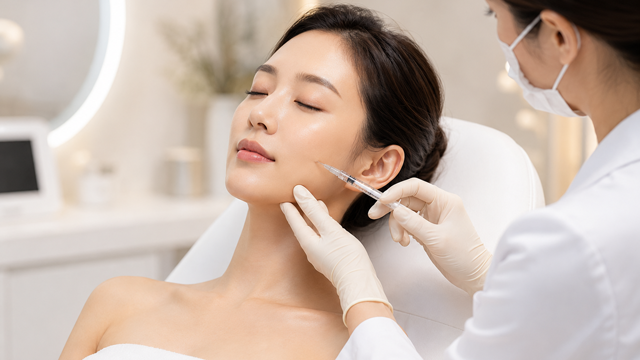
A filler is a gel placed into a chosen location to occupy space. Toxnfill Hongdae describes filler as a non-surgical treatment that injects gel-based substances into targeted areas where facial volume or wrinkle reduction is wanted, and lists the forehead, nose, cheeks, nasolabial folds, under-eyes, lips and chin among the areas treated. Every word in that description is about geography. Where is the deficit, how big is it, what should sit there instead.
A skin booster is not aiming at geography. Toxnfill Hongdae describes skin boosters as injectable treatments designed to support skin hydration, elasticity, texture and an overall healthy-looking appearance, considered for concerns such as dryness, fine lines, rough texture and reduced elasticity. Nothing in that list is a location. All of it is a property of the tissue itself, and those properties are distributed across an area rather than concentrated at a point.
So the useful question is not "what should I have." It is "am I describing a shape or am I describing a surface."
What a Shape Complaint Sounds Like
Shape complaints have a very particular grammar. They tend to involve a specific noun and a preposition. They point.
You hear them in sentences like: the line from my nose to the corner of my mouth has deepened. My cheeks used to sit higher and now they sit lower. There is a hollow under my eye that shows up in every photograph. My chin recedes in profile. My lips have thinned. One side of my jaw is squarer than the other.
Notice what these have in common. Each one names a place. Each one implies a comparison with a shape that either used to exist or that you want to exist. And each one could, in principle, be answered by adding something in that place — which is precisely what a gel filler does. Toxnfill Hongdae states that its filler treatments deliver immediate volumizing effects, smooth static wrinkles and enhance facial proportions, and that results are visible immediately. That immediacy is the signature of a treatment that works by occupying space: the space is occupied the moment the injection is finished.
There is a useful test. Stand in front of a mirror and, with a clean fingertip, press gently upward or outward on the area that bothers you. If a small, well-placed push improves the thing you dislike, your complaint has a shape component. The improvement you produced with your finger is roughly the kind of improvement a filler produces with a gel.
What a Quality Complaint Sounds Like
Quality complaints have different grammar. They use adjectives rather than nouns, and they resist pointing.
They sound like: my skin looks dull no matter what I do. It feels tight and dry by the afternoon. Makeup sits in tiny creases across my cheek that were not there two years ago. The surface looks rough close up. My skin does not bounce back the way it used to. I look tired even when I am not.
Ask someone with this kind of complaint to point at the problem and they will usually wave a hand across a whole region rather than touch a spot. That gesture is diagnostic. A concern that is spread across an area, and that is about how the tissue behaves rather than where it sits, is a skin-quality concern, and adding a gel at one location does nothing for it.
The mirror test fails here, and its failure is informative. Press on a dull, dry, finely creased cheek and you change nothing about dullness, dryness or fine creasing. You have moved the shape slightly and left the quality exactly where it was.
Why These Two Get Confused So Reliably
Three reasons, and each is worth naming because each has to be actively resisted.** Both are injections.** From the patient's chair the experience looks similar enough that the difference is invisible. A clinician cleans the skin, numbs it, and injects something. The syringe does not announce its category."Filler" became the generic word. In ordinary speech, "getting filler" has drifted into meaning "having something injected for the way I look." That drift is harmless in conversation and harmful at a booking desk, because it collapses the exact distinction that the booking needs.** Well-hydrated skin genuinely looks fuller.** This is the most honest source of confusion, and the one that trips up careful people. Skin with better water content and better elasticity reflects light differently and sits differently. It can read, in a photograph, as though a little volume were added. That is a real visual effect, and it is why some people conclude after a booster course that they must have had a small filler without knowing it. But looking fuller and being structurally supported are not the same, and the difference shows up the moment a genuine structural deficit is present. Improving the quality of the skin over a hollow does not fill the hollow.
What Each One Does Not Do, Stated Plainly
This is the part most often left vague, so here it is without hedging.** A dermal filler does not improve the quality of your skin.** It does not make a dry, dull, finely textured surface behave like a hydrated, resilient one. It changes the contour underneath. If your complaint is texture and your treatment is contour, you will have a slightly different shape and the same skin, and you will be disappointed in a way that is hard to articulate because the treatment technically worked.** A skin booster does not correct a structural deficit.** It does not rebuild a lost cheek projection, it does not raise a flattened midface, and it does not build a chin. Toxnfill Hongdae's own framing of the booster category is about hydration, elasticity, texture and overall skin quality — not about volume correction. A person with a genuine contour complaint who receives a course of boosters may well end up with visibly better skin and the identical complaint they arrived with.
Both of those failures are avoidable, and both are avoided in the same way: by describing what bothers you rather than naming the treatment you read about.
Why One Is Placed and the Other Is Distributed
The placement logic follows directly from the job, and once you see it, the two categories stop looking like siblings.
Because a filler has to change a shape, it has to go exactly where the shape is wrong, in an amount calculated for that spot. Toxnfill Hongdae describes its filler consultation as evaluating facial structure, discussing volume targets, selecting the appropriate product and density, and establishing a personalized injection design; the treatment itself is described as including a pre-procedure photograph, topical or local anesthesia, custom area mapping, precise injection and a post-treatment photograph. Mapping and design are not ceremony. They exist because a millimeter of placement error in a structural injection is a visible error.
Because a booster is trying to change the behavior of tissue across a region, it is distributed across that region in many small deposits rather than concentrated in one. There is no single correct point, because there is no single wrong point. The clinic describes the booster sequence in plainer terms — the skin is assessed and prepared, the selected product is administered according to the treatment plan, and aftercare instructions follow — and notes that exact steps depend on which product is chosen.
This difference also explains why the two feel different. Many small entries across a cheek is a different sensation from one or two deeper placements, and the comfort measures used are not identical between the two. How that is handled for any particular treatment is a question worth asking at the consultation, and it is covered in its own right elsewhere in this library.
Why the Courses Look Nothing Alike
Here is the scheduling consequence, and it is the part that matters most if your time is limited.
A shape correction is typically one placement, reviewed later. Toxnfill Hongdae describes filler treatment as taking roughly ten to twenty minutes after twenty to thirty minutes of numbing, requiring only a single clinic visit, with results visible immediately. What follows is not more treatment but observation: swelling settles, the gel integrates, and what you see at two weeks is closer to the truth than what you see that evening. If something needs adjusting, that adjustment is a separate small appointment, not a scheduled part of a series.
A skin-quality change is typically a series. This is not an upsell; it is a consequence of what is being asked. You are not placing an object, you are attempting to shift how a large area of living tissue behaves, and that shift accumulates. Toxnfill Hongdae states that visit requirements for boosters vary according to the product selected, the treatment goals and individual response, which is the honest answer — the number depends on which of its booster options is chosen and on what is being treated.
So the two categories occupy calendar time in opposite ways. One is short and front-loaded with a review afterward. The other is spread out and back-loaded, with the result arriving at the end rather than at the start.
When the Honest Answer Is "Both, in an Order"
A great many people have both problems. Volume falls away and skin quality declines over the same years, for related reasons, and it is entirely normal for an honest assessment to identify a contour deficit and a texture complaint in the same face.
When that happens, the question stops being "which one" and becomes "which one first, and how far apart." That sequencing question is a clinical judgment and it depends on which complaint is doing more of the damage to your appearance, what else is planned, how your skin is behaving at the moment, and how much time you have. Toxnfill Hongdae's position on combining treatments is that combination should be individualized according to skin concerns, treatment compatibility and medical assessment, which is another way of saying that this is not a decision to make from a price list or an article.
What you can do is arrive prepared to have that conversation. Bring both complaints. Do not edit one out because you assume only one can be addressed. And be ready for the plan to run across more than one visit, because a sensible combined plan usually does.
The Practical Consequence If You Are Traveling
If you are in Seoul for a short trip, the difference between these categories is not academic — it is the difference between a complete treatment and a started one.
A structural correction fits a short trip reasonably well. It is a single session, the result is visible immediately, and the remaining work is observation rather than attendance. Toxnfill Hongdae describes immediate return to daily activities after filler treatment, with facial washing and light makeup possible two to three hours afterward, and lists aftercare that runs past the appointment: prescribed oral antibiotics for three days, and avoiding excessive alcohol, saunas, hot baths, strenuous exercise and pressure on the treated area for one to three weeks. That aftercare will follow you home, and it should be written down before you leave the building.
A booster course fits a short trip badly, and pretending otherwise helps nobody. If the plan is a series and your trip holds one session, you will fly home with the first installment of a treatment rather than the treatment. That may still be a reasonable choice, but it should be a choice made with open eyes and discussed explicitly, including what happens to the plan after you land. Raise your travel dates at the start of the consultation rather than at the end. A plan built around your calendar is a different plan from one built without it, and the clinic can only build the first kind if you supply the calendar. You can start that conversation before you fly through the Toxnfill Hongdae contact page.
One more travel-specific point. Both categories can bruise and swell. Toxnfill Hongdae lists temporary bruising, mild swelling, localized pain and a foreign-body sensation among filler side effects, typically resolving within one to two weeks, and lists temporary redness, swelling, tenderness, bruising or small bumps for injectable boosters. If there is an event, a photograph or a flight you care about, the interval between the appointment and that event is part of the decision.
How the Decision Actually Gets Made in the Room
The most reliable thing you can do is describe the complaint rather than request the category.
Say what you see, when you see it, and what makes it worse. "My cheeks look flat in photographs taken from the side" is a useful sentence. "My skin feels rough and looks dull by mid-afternoon" is a useful sentence. "I want filler" is not, because it hands over the diagnosis and asks the clinician to reverse-engineer the problem from the requested solution.
Expect to be assessed rather than simply agreed with. A consultation at Toxnfill Hongdae for filler is described as including evaluation of facial structure and discussion of volume targets; for boosters, as evaluating skin condition, treatment goals, medical history, medications and the areas to be treated. Expect questions about pregnancy or breastfeeding, allergies, medications, active skin infection or inflammation, and previous injectable treatments, because both categories have circumstances in which treatment should be postponed.
And expect the possibility that the answer is neither. Some complaints are not injectable complaints at all. Laxity that needs lifting, pigment that needs a pigment-directed treatment, and active acne all sit outside both of these categories, and a good assessment says so rather than fitting the complaint to the syringe already in the room. The American Academy of Dermatology encourages asking direct questions before any cosmetic treatment, including what the treatment can realistically achieve and what the alternatives are. You can review the clinical team at the clinic's doctors page before you book.
One narrower point worth mentioning and then leaving alone: hyaluronic acid fillers have an established route to being reduced if the placed result is genuinely unwanted, and the materials used in some other injectable categories do not share that route. That asymmetry is real and it belongs in your consultation, but it is a separate subject with its own detail, and it should be discussed with the clinician who would be treating you rather than settled from an article.
The Bottom Line
- A dermal filler changes the shape of your face; a skin booster changes the quality of your skin. Almost every practical difference between them follows from that one line.
- Shape complaints point at a place and often improve when you press on that place with a fingertip. Quality complaints are adjectives spread across a region and do not respond to pressing.
- A filler does not fix texture, dullness or dryness, and a booster does not rebuild a lost contour. Matching the wrong category to your complaint produces a technically successful treatment and a disappointed patient.
- A shape correction is usually a single session reviewed later; a skin-quality change is usually a series, which is why a short trip suits one far better than the other.
- If you have both complaints, say so. Sequencing them is a clinical decision, and it cannot be made without the whole picture and your actual travel dates.
Frequently Asked Questions
Can one injection do both jobs at once?
Some products sit closer to the middle of the range than others, which is exactly why the category names blur. But the honest framing is that a product optimized to hold a shape is not optimized to change the behavior of skin across an area, and the reverse. If both concerns matter to you, treat that as two goals to be planned together rather than one product to be found.
I was told my under-eye needs filler, but my under-eye skin is also crepey. Which comes first?
That is a genuine both-problems situation, and the under-eye is one of the least forgiving areas on the face. The order depends on which is contributing more to what you dislike and on the condition of the skin at the time. This is a judgment for an in-person assessment of that specific area, not a rule that can be stated in advance.
Will a skin booster make my face look bigger?
It is not intended to, and that is not how the category is described. Better-hydrated, more elastic skin can read as fresher and slightly fuller in photographs, but that is a change in how the surface behaves and reflects light rather than added structural volume. If someone is promising a booster will restore lost contour, ask them to explain precisely what they mean.
Why does filler show immediately and a booster does not?
Because a filler occupies space the moment it is placed, and the space is what you were looking at. A booster is asking tissue to behave differently over time, and tissue takes time. Toxnfill Hongdae describes filler results as visible immediately, while the booster category is framed around gradual improvement in skin quality.
How long do the two categories last?
For fillers, Toxnfill Hongdae states that standard options last approximately six to twelve months and premium imported products approximately twelve to twenty-four months. For boosters, duration depends heavily on which product is chosen and on individual response, so ask specifically about the product being proposed to you rather than about the category.
Is there any way to decide this before my consultation?
You can do most of the useful preparation. Write down what bothers you in your own words, in the form of what you see rather than what you want injected. Note when it is worst and what makes it more noticeable. Take a photograph in daylight without a filter. That material is what lets a clinician sort a shape complaint from a quality complaint quickly, and it is far more valuable than arriving with a product name.
This article is for general informational purposes only and is not individualized medical advice or a tool for self-diagnosis. Whether a dermal filler, a skin booster, both or neither is appropriate for you can only be determined by a qualified dermatologist who has examined your skin in person.
Clinical Notice: Individual treatment outcomes and recovery timelines may vary depending on skin condition and personal physiology. Temporary redness, mild swelling, or bruising may occur after treatment; a pre-procedure physician consultation is always conducted.
More Articles
Continue reading our clinical guides.
Toxnfill Hongdae Dermatologist: Meet Dr. Chang Ye Ji
Medically reviewed by Dr. Chang Ye Ji, MD, Chief Director, Toxnfill Hongdae The lead dermatologist at Toxnfill Hongdae is Dr. Chang Ye Ji, who serves as the branch's Chief Director
Learn More

Korean Dermatology Residency Training: How Doctors Qualify
Medically reviewed by Dr. Chang Ye Ji, MD, Chief Director, Toxnfill Hongdae Korean dermatology residency training follows a sequence that will look broadly familiar to an American
Learn More

In-Person Consultation at a Korean Dermatology Clinic
Medically reviewed by Dr. Chang Ye Ji, MD, Chief Director, Toxnfill Hongdae An in person consultation at a Korea dermatology clinic is a working appointment with a defined shape: h
Learn More