Personalized Medical Care & Dedicated International Patient Concierge

Medical Guide
MINT Thread Lift vs DIA Lifting: Design and Results
MINT Thread Lift vs DIA Lifting: How the Two Systems Compare Medically reviewed by Dr. Chang Ye Ji, MD, Chief Director, Toxnfill Hongdae MINT thread lift vs DIA lifting is a choice
Schedule a ConsultationMINT Thread Lift vs DIA Lifting: How the Two Systems Compare
Medically reviewed by Dr. Chang Ye Ji, MD, Chief Director, Toxnfill Hongdae
MINT thread lift vs DIA lifting is a choice between two dissolvable-thread systems, not between a thread and an energy treatment. They separate in two places: how the thread grips the tissue it holds, and how much you must change your habits afterward. MINT's publicly stated distinctive is a 360-degree three-dimensional barb, inserted through fine needles. DIA's is a compression-molded cog made without heat, placed through a blunt cannula. Both give a mechanical lift you can see the same day, so design fit and aftercare tolerance usually decide the choice.
What a Thread Lift Does That an Energy-Based Treatment Does Not
A thread lift moves tissue; an energy-based treatment warms it. That distinction explains most of what follows.
Energy-based lifting works indirectly. The device puts controlled warmth into deeper layers, and the body replies over months by contracting and rebuilding its own structural protein. Nothing is repositioned on the treatment day.
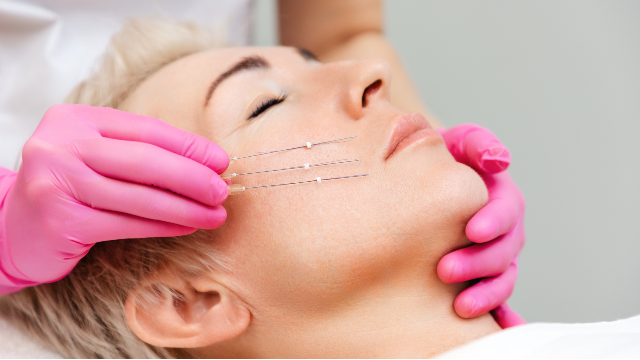
A thread lift works directly. A fine absorbable filament travels beneath the skin along a mapped path, projections along its length catch the surrounding tissue, and as the thread is drawn taut that tissue moves with it and stays where the physician placed it.
Toxnfill Hongdae frames the decision this way: non-surgical laser lifting devices improve elasticity through energy-based mechanisms, whereas thread lifting uses physical dissolvable threads to anchor skin tissue, and the right route depends on skin laxity and facial structure.
The 2024 review of thread-lifting materials in Clinical, Cosmetic and Investigational Dermatology puts the mechanical half plainly: cogs along a barbed thread take hold of tissue physically. Thicker threads present more surface area to nearby tissue, draw a stronger reaction from fibroblasts and stem cells, and that activity continues while the thread is being absorbed.
MINT Thread Lift: The 360-Degree Three-Dimensional Barb
MINT is a minimally invasive thread-lifting procedure using threads with 360-degree three-dimensional barbs to lift and support sagging facial tissue. Because the barbs project on all sides of the filament, the thread engages tissue in more than one direction once seated. It can serve as a targeted treatment for a single area of descent, or be combined with other procedures for full-face lifting.
The sequence runs as a custom design map of the face, a personalized consultation, local anesthesia, precise thread insertion, then a soothing post-care treatment. Dissolvable three-dimensional barbed threads enter the skin tissue through fine needles, where they anchor and draw up areas that have dropped. Comfort throughout insertion is managed with local anesthesia or with topical ointment anesthesia.
Reported benefits include a defined V-line contour, reduced wrinkling, collagen stimulation, better elasticity, and visible lifting of deep facial folds. The appointment runs within 30 to 40 minutes in a single clinic visit. The mechanical lift is immediate, and collagen stimulation keeps building afterward. Overall results last approximately 10 to 18 months, depending on individual skin condition. The thread system is cleared for facial tissue fixation by the US FDA, carries the European CE mark, and is authorized by China's National Medical Products Administration — the agency renamed from the CFDA in 2018 — and by local drug safety agencies.
DIA Lifting: Compression-Molded Cogs and Blunt-Cannula Placement
DIA Lifting is a non-surgical lifting treatment aimed at improving skin firmness and facial contour, and its distinguishing feature is how the thread is made. It uses fifth-generation KFDA-certified dissolvable PDO threads with three-dimensional compression-molding cogs. Those cogs extend a full 360 degrees around the filament, arranged something like rose thorns, giving multi-directional tissue fixation and tensile strength.
The manufacturing method is the part worth pausing on. A non-heated compression process forms dense three-dimensional cogs while the thread keeps its physical structure, its volume and its mass. Insertion then uses blunt cannulas — hollow instruments with rounded, non-cutting tips — chosen to minimize tissue damage, swelling and discomfort.
People request it for immediate V-line lifting and an anti-aging effect with minimal downtime, which lets them resume travel or ordinary activities right away. It is recommended for those wanting a slimmer facial line, those troubled by sagging cheeks, nasolabial folds, marionette lines or a double chin, and those wanting better skin volume and elasticity.
Beforehand, a medical professional evaluates facial structure, skin laxity and tissue thickness to set the treatment areas and the optimal number of threads. The procedure then follows a set order:
- The area is cleansed and prepped.
- Anesthesia is applied — topical numbing ointment plus injected local anesthesia, for comfort during thread placement.
- Blunt cannulas carry the PDO threads into the deep layers of the skin.
- The threads are drawn to anchor sagging tissue.
- The ends are trimmed safely at the entry point.
Benefits include V-line lifting, wrinkle reduction, improved skin tone, collagen stimulation, and structured control of sagging across the cheeks, double chin, neck and eyebrows. The appointment takes approximately 20 to 40 minutes in one visit. Physical lifting shows immediately, while elasticity and collagen improvements keep developing around two weeks afterward. Results are maintained for approximately one year or longer.
MINT vs DIA: The Side-by-Side Picture
Set the two systems side by side:
- Thread design: MINT — 360-degree three-dimensional barbs. DIA — three-dimensional compression-molding cogs extending 360 degrees, on fifth-generation PDO material.
-Manufacturing distinctive: MINT — the barb geometry itself. DIA — a non-heated compression method preserving thread structure, volume and mass while building dense cogs.
-Insertion instrument: MINT — fine needles. DIA — blunt cannulas, chosen to reduce tissue trauma.
-Anesthesia: MINT — local anesthesia or topical ointment anesthesia. DIA — topical numbing ointment plus injected local anesthesia.
-Session length: MINT — within 30 to 40 minutes, single visit. DIA — approximately 20 to 40 minutes, single visit.
-When the lift appears: both immediately, by mechanical action.
-When collagen change appears: MINT — building progressively afterward. DIA — still developing around the two-week mark.
-How long results hold: MINT — approximately 10 to 18 months, varying with skin condition. DIA — approximately one year or more.
-Washing and makeup: MINT — permitted 2 to 3 hours afterward. DIA — allowed the following day.
-Longest restriction: MINT — dressings on the puncture points until healed. DIA — guarded jaw and head movement for four weeks.
Neither column is better in the abstract; fit depends on your face and your schedule.
Why the Result Can Outlast the Thread
PDO resorbs in six to eight months, according to the 2024 review in Clinical, Cosmetic and Investigational Dermatology. Set that against result windows of 10 to 18 months and one year or more, and it looks like a contradiction. It is not.
The thread does two jobs. The mechanical one — gripping and holding tissue in a lifted position — ends when the material is fully absorbed. The biological one continues. As the same review describes, the thread's presence provokes fibroblasts and stem cells, and that regenerative response carries on throughout absorption. Fresh collagen is laid down along the paths the threads traveled, so your own tissue has rebuilt part of the support by the time the filament is gone.
That is also why the collagen half is never instant. The American Society for Dermatologic Surgery makes the point that when an improvement depends on newly formed collagen, roughly three to six months is the earliest realistic window before it becomes apparent. The two effects are stacked, not simultaneous.
Two details from the review place the numbers. Mesh-scaffold PDO variants acquire most of their tissue-ingrowth holding strength within about two weeks. And material drives longevity across the category: poly-L-lactic acid resorbs in around 12 months, polycaprolactone beyond one to one and a half years, and one poly-L-lactic-acid-based system sustains its result around 18 to 24 months.
What Independent Evidence Says About Durability and Satisfaction
Independent follow-up shows satisfaction that is very high at first and slightly lower later. In the 2024 review in Clinical, Cosmetic and Investigational Dermatology, satisfaction stood at 98% immediately after treatment and settled at 88% over the longer term. Almost everyone likes the immediate change; a smaller share feels differently once the lift has softened. Neither figure promises anything about your face, but both help calibrate expectations a year out.
Manufacturer-side evaluation data belongs beside them. Clinical evaluations of the MINT thread system are reported to demonstrate a 96.72% improvement rate in wrinkles and skin sagging. That is an evaluation outcome for the system rather than a forecast for an individual. Skin thickness, degree of laxity, age, facial structure and adherence to aftercare all shape what any one person gets.
The US Food and Drug Administration is direct about the same caution. Its guidance for people considering aesthetic procedures notes that an outcome may prove temporary, that it may not reach what someone hoped for, and that risk accompanies every device.
The Complication Picture, Reported in Proportion
Most thread-lift side effects are mild, brief and expected; the serious ones are rare but documented.
What the pooled data shows
A meta-analysis of 26 studies, summarized in the 2024 review in Clinical, Cosmetic and Investigational Dermatology, put pooled complication rates at:
- Swelling: 35%
- Dimpling: 10%
- Altered sensation: 6%
- Thread visibility or palpability: 4%
- Infection: 2%
- Extrusion, where a thread works its way toward the surface: 2%
Two patterns inside that data are practically useful. Absorbable threads, the kind used in both systems here, carried lower risk of altered sensation and of extrusion than non-absorbable threads. Patients over 50 showed higher risk of both dimpling and infection, which is one reason age enters the assessment.
Expected effects at the clinic sit at the mild end of that distribution. After MINT, you may see temporary localized bruising, mild swelling, pain, or minor infection at the needle entry sites. After DIA Lifting, temporary bruising, mild swelling, localized pain, and a slight sensation of something foreign present are all recognized, and mild swelling and bruising generally clear within one to two weeks. The American Society for Dermatologic Surgery gives a comparable outer boundary for non-invasive tightening: visible swelling and bruising may need up to about two weeks to settle, while redness usually fades within hours. Less commonly after DIA Lifting, a thread may extrude or irritation may persist, and either calls for medical follow-up.
What one published case teaches about follow-up
A 2022 case report in Plastic and Reconstructive Surgery Global Open shows why prompt follow-up is not a formality. A woman in her early fifties presented one month after a four-thread barbed PDO lift with abscesses tracking along the paths the threads had taken. She received a five-day course of a combination of oral antibiotics, and the threads were then removed surgically because the skin had begun to ripple. They proved fragile and several incisions were needed to extract them. The inflammation resolved at one month, but a permanent deformity remained because treatment had been delayed.
The authors of that report observed that only eight serious PDO thread complications had appeared in the published literature at the time they wrote, so one case is not a base rate. It does explain why aftercare instructions are specific, and why unusual pain, spreading redness, discharge or a change in contour deserves a call rather than patience.
The Two Aftercare Regimes Compared
This is where the treatments genuinely diverge, and for many people it decides the question.** After MINT Thread Lift:**- Face washing and light makeup are permitted 2 to 3 hours after treatment.
Hydrocolloid dressings over the puncture points should stay attached until those points have healed.
Follow the prescribed oral medication routine and the self-care precautions you are given.
No downtime is required, and you can return to daily activities immediately.** After DIA Lifting:**
Facial washing and light makeup are allowed the following day.
Take the prescribed anti-inflammatory or pain-relief medication for 3 days.
Avoid excessive alcohol, saunas, hot baths and strenuous exercise for 1 week.
Apply cold compresses for the first 3 days.
Avoid opening the mouth widely, laughing loudly, or making sudden head movements for 4 weeks.
You can return to your daily routine right away within those limits.
The four-week movement restriction deserves the most thought. It does not confine you to your home, but it asks you to modify ordinary behavior: smaller bites, no wide yawning where avoidable, restrained laughter, no sharp turns of the head. The cogs need undisturbed time to hold position while tissue settles around them.
For a visitor with a short itinerary that difference is concrete. Washing your face within a few hours is not the same as a next-day wash, cold compresses, and a month of measured jaw movement.
Preparation differs slightly too. Both ask you to hold off on blood-thinning medication or supplements beforehand as advised. Before MINT, alcohol and anti-inflammatory medications are also avoided as your physician directs, which lowers bruising risk; before DIA Lifting, you disclose your medical history and any antibiotic allergies.
Who Should Not Have Either Treatment
Both systems share most of their exclusions.
MINT generally suits adults with mild-to-moderate facial laxity, with suitability confirmed at consultation. It is not recommended for people who are pregnant or breastfeeding, who have severe skin infections or open wounds at the insertion site, who have active autoimmune conditions, or who have severe bleeding disorders.
DIA Lifting is likewise unsuitable for people with active skin infections, severe bleeding disorders or uncontrolled autoimmune conditions, and for those who are pregnant or nursing. Its exclusion list adds one non-medical item that deserves respect: people holding unrealistic expectations of what non-surgical skin tightening can achieve. A thread lift repositions tissue that has descended; it is not a substitute for surgery when laxity is advanced.
Published guidance converges on the same list. Non-invasive tightening is discouraged by the American Society for Dermatologic Surgery where there is an infection in the area to be treated, a clotting disorder, or an ongoing pregnancy.
Why Operator Experience Weighs More Here
A thread lift is technique-dependent in a way a device-delivered treatment is not, so who performs it matters more.
With an energy-based treatment, the device governs much of what reaches the tissue. With a thread lift, a person decides the vector of the pull, the depth of the plane, the entry points, the thread count and the tension applied — which is why DIA's pre-treatment evaluation of facial structure, skin laxity and tissue thickness exists at all.
That is why the question list published by the American Academy of Dermatology fits thread lifting better than almost any other aesthetic category. The Academy suggests you:
- Ask the physician to put a number on how often they have carried out the specific procedure you are considering, not the category in general.
- Ask how frequently they treat people whose skin tone, skin type and age range resemble yours.
- Ask to view photographs of outcomes from patients that physician treated personally.
The FDA adds the framing question underneath those: talk through the benefits, the risks and whether you are a suitable candidate before committing, and ask directly about that provider's training and experience. To learn who would be looking after you here, start with the Toxnfill Hongdae team page.
Threads and Volume Treatments Solve Different Problems
Threads and injectables are often planned together because they address different mechanisms, not because one reinforces the other.
A thread lift repositions tissue that has migrated downward. A filler replaces volume that has been lost. Sunken and sagging are not the same complaint. Longevity differs too: the American Academy of Dermatology reports that injectable hyaluronic acid gel typically lasts 4 to 12 months, that poly-L-lactic acid runs 1 to 3 years, and that a patient's own transferred fat also lasts 1 to 3 years. Minor effects from injectables, such as redness, swelling, tenderness and occasional bruising, usually settle within 7 to 14 days.
In practice, MINT is often folded into full-face plans alongside mono smooth threads or dermal fillers, so lifting and volume enhancement happen together. DIA Lifting is frequently paired with botulinum toxin, hyaluronic acid dermal fillers, or skin booster injections. The alternatives named alongside DIA Lifting are energy-based lifting, laser skin tightening, or conventional facelift surgery.
Making the Choice on Assessment Rather Than Reputation
The decision comes down to how lax your skin actually is, how your face is structured beneath the surface, and how much aftercare restriction your life can absorb.
Laxity determines whether a thread lift is the right category at all. Facial structure determines the vectors, the entry points and the thread count a result would require. Aftercare tolerance is the practical filter — if four weeks of guarded jaw movement is unworkable for you, raise it early. Skin thickness, the pattern of descent and your medical history can only be evaluated in person, so when you are ready for that assessment you can reach the clinic here.
The Bottom Line
- Both are dissolvable-thread procedures that reposition sagging tissue mechanically, unlike energy-based treatments that heat tissue to prompt collagen change.
- MINT uses 360-degree three-dimensional barbs placed through fine needles; DIA uses fifth-generation PDO threads with non-heated compression-molded cogs placed through blunt cannulas.
- Results run approximately 10 to 18 months for MINT and one year or more for DIA, both outlasting the six-to-eight-month PDO resorption period reported in Clinical, Cosmetic and Investigational Dermatology, because collagen forms while the thread breaks down.
- Aftercare is the sharpest practical difference: MINT permits washing and light makeup within 2 to 3 hours, while DIA asks for a next-day wash, cold compresses, and four weeks of restrained jaw and head movement.
- Because thread placement is judgment-dependent, the American Academy of Dermatology's advice to probe a physician's specific experience carries particular force here.
Frequently Asked Questions
What does the difference in thread design mean in practice?
MINT threads carry 360-degree three-dimensional barbs, so the filament engages tissue around its whole circumference once positioned. DIA threads carry cogs formed by compression molding without heat, which preserves the thread's structure, volume and mass while producing dense cogs that also extend a full 360 degrees. Both aim at multi-directional fixation, and the 2024 review in Clinical, Cosmetic and Investigational Dermatology confirms that cogs hold tissue mechanically.
How long does each result last?
MINT results last approximately 10 to 18 months, depending on individual skin condition. DIA Lifting results are maintained for approximately one year or more. In both cases the mechanical lift is visible immediately, while the collagen-related component builds afterward — around two weeks after DIA Lifting, elasticity and collagen improvements are still developing.
How long does each procedure take?
MINT is completed within 30 to 40 minutes in a single clinic visit. DIA Lifting takes approximately 20 to 40 minutes, also finished in one visit. Both figures cover the treatment itself, which follows the design mapping and anesthesia stages.
When can I wash my face and wear makeup afterward?
After MINT, face washing and light makeup are permitted 2 to 3 hours after treatment, and hydrocolloid dressings over the puncture points stay in place until those points have healed. After DIA Lifting, facial washing and light makeup are allowed the following day.
What does the four-week movement restriction after DIA Lifting involve?
For four weeks you avoid opening your mouth widely, laughing loudly, and making sudden head movements, so the cogs get undisturbed time to hold position while surrounding tissue settles. Alongside that, cold compresses are applied for the first three days, prescribed anti-inflammatory or pain-relief medication is taken for three days, and excessive alcohol, saunas, hot baths and strenuous exercise are avoided for one week.
What complication rates have been published for thread lifting?
A 26-study meta-analysis summarized in the 2024 review in Clinical, Cosmetic and Investigational Dermatology reported pooled rates of 35% for swelling, 10% for dimpling, 6% for altered sensation, 4% for thread visibility or palpability, 2% for infection and 2% for extrusion. That review also found absorbable threads carried lower risk of altered sensation and extrusion than non-absorbable ones.
Who is not a candidate for either treatment?
Neither procedure is recommended during pregnancy or while breastfeeding or nursing, nor for people with severe bleeding disorders, severe or active skin infections at the treatment site, or active or uncontrolled autoimmune conditions. DIA Lifting additionally is not suitable for someone whose expectations of non-surgical skin tightening are unrealistic. Suitability for either is settled at consultation.
This article is for general informational purposes, does not constitute individualized medical advice, and is not a self-diagnosis tool. Thread materials, product specifications and aftercare protocols are revised over time. Only a qualified dermatologist or physician who has examined your face in person can tell you whether a thread lift fits your skin and your goals.
Clinical Notice: Individual treatment outcomes and recovery timelines may vary depending on skin condition and personal physiology. Temporary redness, mild swelling, or bruising may occur after treatment; a pre-procedure physician consultation is always conducted.
More Articles
Continue reading our clinical guides.

Toxnfill Hongdae Dermatologist: Meet Dr. Chang Ye Ji
Medically reviewed by Dr. Chang Ye Ji, MD, Chief Director, Toxnfill Hongdae The lead dermatologist at Toxnfill Hongdae is Dr. Chang Ye Ji, who serves as the branch's Chief Director
Learn More

Korean Dermatology Residency Training: How Doctors Qualify
Medically reviewed by Dr. Chang Ye Ji, MD, Chief Director, Toxnfill Hongdae Korean dermatology residency training follows a sequence that will look broadly familiar to an American
Learn More

In-Person Consultation at a Korean Dermatology Clinic
Medically reviewed by Dr. Chang Ye Ji, MD, Chief Director, Toxnfill Hongdae An in person consultation at a Korea dermatology clinic is a working appointment with a defined shape: h
Learn More