Personalized Medical Care & Dedicated International Patient Concierge

Medical Guide
Male Botox in Korea: Treatment Options for Men Explained
Medically reviewed by Dr. Byun Sung Ho, MD, Director, Toxnfill Hongdae Men who search for male Botox Korea are usually not shopping for a category. They are describing something sp
Schedule a ConsultationMedically reviewed by Dr. Byun Sung Ho, MD, Director, Toxnfill Hongdae
Men who search for male Botox Korea are usually not shopping for a category. They are describing something specific: a shoulder line that looks heavy in a shirt, skin that reads rough or tired in photographs, or hair that returns two days after shaving. Dermatology treatment for men in Korea answers those three complaints with three different mechanisms, and the mechanism you need depends entirely on which tissue is causing the appearance you dislike. This article walks through the treatments at Toxnfill Hongdae in Seoul that map onto those concerns, and what each one involves in practice.
Three Different Tissues, Three Different Tools
The single most useful thing to understand before booking is that muscle, skin and hair are treated by unrelated methods, and no method substitutes for another.
- Muscle volume and muscle-driven creasingare addressed with botulinum toxin, which temporarily reduces activity in the muscle it is placed into. It does not add volume and it does not change skin quality.
-Skin quality— texture, hydration, firmness, fine lines — is addressed with injectable skin boosters, which are placed into the skin itself rather than into muscle.
-Unwanted hair is addressed with laser treatment aimed at the pigment inside the hair follicle. It has no effect on muscle bulk and is not a skin-quality treatment.
That sorting matters because two men with the same complaint — "my neck and shoulders look thick" — can leave with different plans. One may have overdeveloped trapezius muscle; the other may be describing skin laxity or neck wrinkling. Toxnfill Hongdae's own framing for its neck and trapezius injectable treatment makes the same distinction: the appropriate option depends on whether muscle prominence, skin laxity or wrinkles is the primary driver. When you state which concern you want examined first, you make that triage possible before you are in the chair.
Trapezius Botox for Men: What the Injection Is Aimed At
Trapezius injection targets a large postural muscle, not a cosmetic surface. Understanding its shape explains why the treatment is mapped rather than standardized.
StatPearls, hosted on the NCBI Bookshelf at the National Library of Medicine, describes the trapezius as a broad, thin, triangular muscle covering the upper back, shoulders and neck. It has three distinct fiber groups — upper, middle and lower. The upper fibers elevate and upwardly rotate the shoulder blade and extend the neck; the middle fibers draw the shoulder blades together; the lower fibers depress the shoulder blade. Motor supply comes from the spinal accessory nerve, the eleventh cranial nerve, while sensory function is carried by the ventral rami of the third and fourth cervical nerves. The same reference notes that the muscle is primarily postural, holding the spinal column erect when you stand, and that uneven development across its three portions produces muscle imbalance and disturbed posture.
Two things follow. "The trapezius" is not one target: the visible ridge from neck to shoulder is largely upper fibers, a different region from the sheet spanning the mid-back. And this is working tissue with a real job, which is why dose and placement are decided individually.
Toxnfill Hongdae describes its Neck Wrinkle and Trapezius treatment as a non-surgical injectable that can relax developed muscle and soften the appearance of certain wrinkles. For the trapezius specifically, the stated aim is to soften prominent muscle volume and produce a smoother neckline. The clinic groups this with its body-focused botulinum toxin work, which it describes as targeting developed muscles such as the trapezius to create a softer overall contour. The practice also supports a functional claim: helping reduce discomfort associated with tight or knotted muscle. For men whose shoulders carry desk posture, bag straps or gym loading, that point is often the more relevant one.
Who the clinic considers a candidate
Candidacy is described in terms of the muscle and the skin, not the patient's demographic. Adults with visible neck wrinkles or with prominent or overdeveloped trapezius muscles may be suitable, and suitability is judged on muscle development, skin condition, anatomy and the individual's stated goal.
The clinic also sets out circumstances that call for avoidance or postponement. Certain neuromuscular conditions, allergy to botulinum toxin ingredients, infection at the intended injection site, and other medical contraindications all require medical assessment first.
How the appointment runs
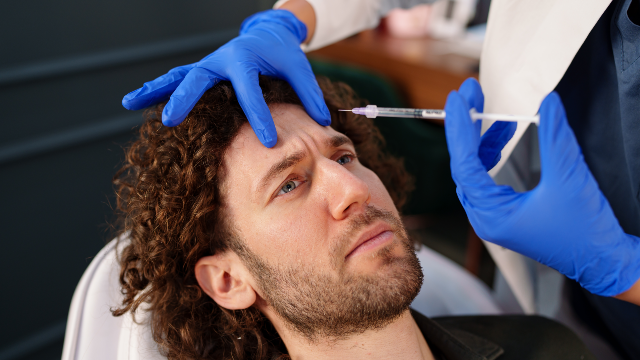
The consultation examines the neck and shoulder anatomy, how developed the muscle is, the wrinkle pattern, the skin condition and the outcome you want. The injection map and treatment plan are then set from that assessment. On the day, the area is assessed and cleaned, and botulinum toxin is placed into selected muscles using a fine needle, with the number and position of injections following the treated area and your own anatomy. General anesthesia is not used; the needle is fine, discomfort is brief, and additional comfort measures can be considered where appropriate. The visit itself is a short outpatient appointment with no hospitalization, and the time it takes tracks the number and location of areas being treated.
Results here are progressive rather than instant, and they are temporary. Repeat treatment may be needed, depending on your individual response and on which area was treated. The clinic is explicit that the goal for trapezius work is a smoother, softer neckline rather than a permanent change to the muscle.
The restrictions that follow trapezius injection
This is the part men most often underestimate, because the aftercare is stricter than for facial injection and it collides with training and travel.
- Heavy exercise, excessive drinking, saunas and jjimjilbangs, and hot baths are all avoided for three to five days.
- Rubbing or otherwise irritating the treated area is avoided.
- After trapezius treatment specifically, heavy lifting is avoided for roughly two weeks.
- Carrying a bag on one side is also avoided across that same two-week window.
If you lift, row, or plan to move luggage through an airport, that two-week restriction is worth building into the trip before you book rather than discovering afterward.
Risks to hear before agreeing
Temporary effects reported at the injection site include pain, bruising, swelling, pulling sensations, mild pain and throbbing. Uncommon effects include temporary weakness or asymmetry, and — particularly with injections into the neck — neck weakness or difficulty swallowing. Any unusual or persistent symptom should be assessed by a medical professional rather than waited out. The clinic's stated approach to reducing that risk is to select injection sites and doses according to muscle anatomy, the treated area and the outcome you asked for.
Male Jawline Botox in Korea: When Muscle Is the Cause
Botulinum toxin at this practice is not limited to the trapezius. The jaw is among the listed treatment areas, alongside the forehead, glabella, outer eyes and salivary glands. Where a heavy lower face is driven by muscle bulk rather than by fat or by skin laxity, muscle is the tissue that has to be addressed — and the clinic's own comparison of options makes the point that fat-focused injections, lifting treatments and filler each answer a different contributor. Naming the contributor is the consultation's job.
Men's Skin Treatment at a Seoul Clinic: Where Boosters Fit
Skin boosters are placed into the skin to change its condition rather than its shape. Toxnfill Hongdae describes them as injectable treatments supporting hydration, elasticity, texture and overall skin appearance, with individual options aimed at dryness, fine lines, rough texture and reduced elasticity.
That list maps closely onto what men commonly describe when they say their skin looks tired: coarse texture across the cheeks and nose, dullness, and lines that have started holding after the expression relaxes. The clinic frames candidacy as adults seeking improvement in hydration, texture, fine lines, firmness or overall skin quality following an appropriate medical assessment. Its booster menu includes several named options — among them Skinvive, Water Glow Injection, Juvelook, Sculptra, Laetigen and a premium low-pain Rejuran option — and the benefit each is positioned for differs by product, spanning hydration, radiance, firmness, wrinkle improvement, regeneration and collagen stimulation.
The procedure itself is short in outline: the skin is assessed and prepared, the selected booster is administered according to the plan, and post-treatment instructions are given. Recovery for injectable skin treatment is generally brief. Temporary redness, swelling, tenderness, bruising or small bumps at the injection points can occur, and product-specific risks are discussed before treatment rather than after. Suitability is settled by reviewing medical history, skin condition, allergies, medications and treatment-specific contraindications, and the consultation expects an account of what you take, what you react to, which cosmetic treatments you have already had, and any medical condition that bears on the decision.
Hair: Why Density and Coarseness Differ Between Individuals
The reason a beard or a chest responds differently from a forearm is biological, and it is well documented in public reference material.
StatPearls records that at birth the body is covered in fine vellus hair, apart from terminal hair on the scalp, eyelashes and eyebrows. During puberty, androgens act on some of those vellus hairs — including on the face, the underarms and the trunk — and convert them into terminal hairs, which are longer, thicker and pigmented. That conversion is why the beard area, chest and back are typically fields of coarse, heavily pigmented hair rather than fine down, and it is the single most useful fact to carry into a hair-reduction consultation.
MedlinePlus, the National Library of Medicine's consumer health service, puts healthy hair growth at about half an inch a month, and notes that most hairs grow for up to six years before falling out and being replaced. MedlinePlus also lists folliculitis and ingrown hair among the common problems affecting hair and the skin around it, which is precisely the territory of shaving irritation in the beard and neck.
What Laser Hair Reduction Does, and What It Does Not
Laser hair treatment reduces hair. It is not depilation and it is not permanent removal, and the clinic states that plainly.
The mechanism is well described. StatPearls explains that lasers used on skin work by selective photothermolysis — light of a chosen wavelength is preferentially absorbed by a specific target, called a chromophore, which is heated while surrounding tissue is comparatively spared. For hair treatment the chromophore is melanin, which absorbs light across roughly 300 to 1200 nanometers, and devices used for hair reduction emit in that band. Because melanin sits in far higher concentration in the hair shaft and matrix than in the follicle wall, the pigment captures the energy and passes heat outward to the surrounding follicular structures. That reference describes several device families — alexandrite at 755 nanometers, diode at 810 nanometers and neodymium-doped yttrium-aluminium-garnet at 1064 nanometers — each with a different penetration depth and profile across skin tones.
Two consequences of that mechanism decide how a course is built. First, StatPearls notes that the hair matrix is only sensitive during the anagen — actively growing — phase of the cycle, so repeated sessions are required to catch each follicle at the moment it is vulnerable. Second, the same reference states that the procedure delivers permanent hair reduction rather than removal, and that maintenance sessions every six to twelve months may be wanted because fine vellus hair can return.
StatPearls also lists the factors that shift the outcome: the site treated, skin and hair color, the growth stage caught, the type of laser, hormonal status and the treatment plan. On site specifically, it records that underarm and pubic hair respond better than hair on the limbs and chest — a directly relevant caveat if the chest or back is your main area. Beyond aesthetics, it lists medical indications for laser hair treatment including pseudofolliculitis barbae — the razor-bump reaction familiar to many men who shave the neck — as well as pilonidal sinus and acne keloidalis nuchae.
What the FDA record shows for the Candela platform
Toxnfill Hongdae's hair-reduction program names GentleMax Pro, a Candela platform. The FDA's public 510(k) database carries a clearance for that device family.
- The 510(k) number is K133283, for the device named CANDELA GENTLEMAX FAMILY OF LASER SYSTEMS.
- The applicant is Candela Corp. of Wayland, Massachusetts.
- The device classification name is "Powered Laser Surgical Instrument", under regulation number 878.4810, product code GEX.
- The application was received on October 25, 2013, and the decision date is December 26, 2013.
- The decision recorded is Substantially Equivalent, and the submission type is Special.
That is a 510(k) clearance, which means the FDA agreed the device is substantially equivalent to a legally marketed predicate. It is a different regulatory pathway from premarket approval, and the correct word for it is "cleared". You can look the record up yourself by 510(k) number in the FDA's database — a useful habit for any device a clinic names to you.
How a hair-reduction session runs here
The clinic's sequence is short and consistent. The consultation evaluates the skin, maps the treatment zones and reviews your medical history, and pre-treatment photographs are taken as a record. A topical anesthetic ointment is then applied for approximately 20 to 30 minutes before the laser is used. Spot size and energy level are set to your hair density and the specific area being treated, and the systems used are described as non-contact with strong cooling built in.
Preparation is on you and it matters:
- Shave the area one to two days before the appointment, so a short target remains without excess hair above the skin.
- Do not wax or pluck hair during the treatment period, because the follicle has to still be present for the laser to work on it.
- Avoid tanning and sunbathing, and do not present with recently sun-exposed skin.
- Treatment is postponed over skin infections, open wounds, significant irritation or sunburn.
Timing is modest per visit. Each area takes roughly 5 to 10 minutes. Return visits are recommended at four-to-six-week spacing, and the full plan runs to five sessions or more, with the exact number following how much hair there is and what it is like. Areas treated at the practice span facial and body regions, including the face, underarms, arms and legs.
Aftercare for a hair-reduction session
This aftercare is looser than for injectable treatment, and worth reading exactly rather than assuming.
- Makeup, cleansing and showering are all permitted the same day.
- Sauna, swimming pools and comparable activities are avoided for about one week.
- Sunscreen is applied to treated areas that will be exposed.
- Moisturizer is used if the skin feels dry afterward.
What the result looks like over time
Nothing disappears on the table. Treated hairs shed naturally across the following one to two weeks. Temporary redness or slight swelling can occur for about one to two days, and normal daily activity resumes immediately. Uncommonly, folliculitis, blistering or scabbing can follow, and reported risks across laser hair treatment more broadly include burns, pigment change, scarring and, in rare cases, paradoxical hair growth. Risk varies with skin type, the settings used and sun exposure afterward.
The clinic's own account of durability is measured. Growth cycles may noticeably slow after a single session. Past five treatments, hair thickness and the growth cycle may be reduced on a semi-permanent basis, and after a course of five to ten sessions the practice describes maintenance holding for upwards of three years. It is equally explicit that this is reduction, not permanent removal — which matches the published clinical reference. Shaving and waxing, by contrast, remove hair only temporarily without affecting the follicle at the root, so they need repeating far more often.
Sorting Your Own Complaint Before You Write In
You will get a better consultation if you arrive with a description rather than a product name. A useful way to phrase it:
-"The ridge between my neck and shoulder looks heavy and feels tight." That points at muscle volume and at the trapezius assessment.
-"My lower face looks wide and it is not fat." That points at whether jaw muscle is the contributor, which is an assessment question rather than a self-diagnosis.
-"My skin looks coarse and dull rather than lined." That points at skin quality and the booster route.
-"Lines are staying visible after my face relaxes." That is a different finding from lines that only appear on movement, and the distinction changes the plan.
-"I get razor bumps on my neck within a day of shaving." That points at the hair and the follicle rather than at the skin surface alone.
Bringing one primary concern and one secondary concern works better than a list of six. It is also worth reading how the clinic sets out its own clinical scope beforehand, so the categories in the conversation are not new to you.
The Bottom Line
- Muscle, skin and hair are treated by three unrelated mechanisms, and the useful first step is identifying which tissue is producing the appearance you want changed.
- Trapezius botulinum toxin aims at softening prominent muscle volume and the neckline, with a supporting claim around discomfort in tight muscle — and it is explicitly not a permanent change.
- Trapezius aftercare is stricter than facial aftercare: three to five days off heat, alcohol and hard training, and about two weeks without heavy lifting or one-sided bag carrying.
- Laser treatment delivers hair reduction rather than removal; the clinic's plan runs five sessions or more at four-to-six-week spacing, at roughly 5 to 10 minutes per area.
- The FDA's 510(k) record K133283 shows the Candela GentleMax family as cleared under a Substantially Equivalent decision dated December 26, 2013 — a clearance, not an approval.
Frequently Asked Questions
Does trapezius injection make me weaker in the gym?
The trapezius is a working postural muscle, and the treatment temporarily reduces activity in the muscle it is placed into. That is why the clinic advises avoiding heavy lifting for around two weeks afterward and not carrying a bag on one side during that window. Discuss your training load at consultation so dose and placement can be planned around it.
Is the injection into my neck riskier than into my forehead?
The reported risks differ by site. For neck injection specifically, uncommon effects include neck weakness and difficulty swallowing, alongside the more general possibilities of temporary weakness and asymmetry. The clinic's stated safeguard is selecting injection points and doses from the muscle anatomy and treated area rather than applying a fixed pattern.
Why do I need five or more laser hair sessions instead of one?
Because only follicles in the actively growing phase are susceptible to the laser, and at any moment your hairs are spread across different phases of the cycle. StatPearls notes the hair matrix is sensitive during the anagen phase, which is why repeated sessions are needed to reach each follicle at the right point. The clinic's plan reflects that, with returns at four-to-six-week spacing.
Will laser treatment stop my beard growing back permanently?
No. Both the clinic and the published clinical reference describe the outcome as hair reduction rather than permanent removal. Thickness and growth cycle can be reduced on a semi-permanent basis past five treatments, and StatPearls notes that maintenance sessions every six to twelve months may be wanted because fine hair can return.
Can my chest and back be treated the same way as my underarms?
They can be treated, but the expected response differs by site. StatPearls records that underarm and pubic hair respond better than hair on the limbs and chest, so the chest and back are worth discussing as their own case. Skin tone, hair color and your medical history also feed into whether and how the area is treated.
What should I do about shaving before my laser appointment?
Shave the area one to two days ahead, so there is a short target left at the skin without a long shaft absorbing energy. Do not wax or pluck during the treatment period, because the follicle has to remain in place for the laser to act on it. Avoid tanning beforehand, and postpone if the skin is irritated, infected or sunburned.
Is there anything at this clinic aimed at skin texture rather than lines?
Yes. The injectable skin boosters are positioned for skin condition rather than shape, targeting hydration, texture, elasticity and firmness, with individual products aimed at concerns such as dryness and rough texture. Candidacy is assessed medically, and your medication list, allergies and treatment history come up before anything is administered.
Can the razor irritation on my neck be addressed at the same visit as anything else?
Shaving irritation sits with the hair and the follicle, and MedlinePlus lists folliculitis and ingrown hair among the common problems affecting hair and surrounding skin. Laser hair treatment is documented in the clinical literature as having medical indications including pseudofolliculitis barbae. Whether it is appropriate for your skin and hair is a consultation finding, so raise the shaving reaction alongside your other concerns when you first make contact.
This article is for general informational purposes and does not constitute individualized medical advice, and it is not a self-diagnosis tool. Treatment candidacy, technique, and expected outcomes can only be determined through a consultation with a qualified dermatologist.
Clinical Notice: Individual treatment outcomes and recovery timelines may vary depending on skin condition and personal physiology. Temporary redness, mild swelling, or bruising may occur after treatment; a pre-procedure physician consultation is always conducted.
More Articles
Continue reading our clinical guides.
Toxnfill Hongdae Dermatologist: Meet Dr. Chang Ye Ji
Medically reviewed by Dr. Chang Ye Ji, MD, Chief Director, Toxnfill Hongdae The lead dermatologist at Toxnfill Hongdae is Dr. Chang Ye Ji, who serves as the branch's Chief Director
Learn More
Korean Dermatology Residency Training: How Doctors Qualify
Medically reviewed by Dr. Chang Ye Ji, MD, Chief Director, Toxnfill Hongdae Korean dermatology residency training follows a sequence that will look broadly familiar to an American
Learn More
In-Person Consultation at a Korean Dermatology Clinic
Medically reviewed by Dr. Chang Ye Ji, MD, Chief Director, Toxnfill Hongdae An in person consultation at a Korea dermatology clinic is a working appointment with a defined shape: h
Learn More