Personalized Medical Care & Dedicated International Patient Concierge

Medical Guide
In-Person Consultation at a Korean Dermatology Clinic
Medically reviewed by Dr. Chang Ye Ji, MD, Chief Director, Toxnfill Hongdae An in person consultation at a Korea dermatology clinic is a working appointment with a defined shape: h
Schedule a ConsultationMedically reviewed by Dr. Chang Ye Ji, MD, Chief Director, Toxnfill Hongdae
An in person consultation at a Korea dermatology clinic is a working appointment with a defined shape: history, examination, assessment with whatever tool the treatment requires, a marked-up plan, and a risk conversation. At Toxnfill Hongdae the pattern repeats across treatment families, which means you can walk in knowing the sequence even if you do not yet know which treatment you will be offered.
This guide walks through that sequence step by step, names the assessment tools you may encounter, and explains where the appointment differs from a dermatology visit in the United States.
The shape of the appointment
At Toxnfill Hongdae, a medical consultation and an individualized plan come before treatment, and the settings used are chosen against the patient's own condition. In practice that unfolds as five stages: intake and history, examination of the area, selection of an approach with its specific settings, a design and marking step for anything spatial, and a risk-and-aftercare conversation before consent.
Some treatments compress this into a few minutes. Others extend it. A botulinum toxin appointment for a familiar area is short; a first assessment for facial lifting or filler contouring is not, because the plan is spatial and has to be drawn.
Intake: what you will be asked
The history-taking is consistent across the clinic's treatment families, and its content is predictable enough to prepare for.
Expect questions about your skin concerns and treatment goals, your medical history, current medications, allergies, and previous cosmetic procedures. For collagen-stimulating injections and fillers the review extends to prior aesthetic procedures in the same area. For botulinum toxin the practitioner reviews concerns, medical history, medications, and goals, then examines the target muscles. For IV and wellness injections the review covers health condition, allergies, medications, and the intended goal.
Two categories of answer change plans most often. The first is medication and bleeding risk. The second is anything that makes a treatment inadvisable right now rather than in general — active skin infection, significant inflammation, recent tanning or sunburn, pregnancy or breastfeeding, and certain neuromuscular conditions where botulinum toxin is concerned. Bring a written list rather than relying on recall, and include supplements.
Examination and the assessment tools
This is where a Korean aesthetic consultation often differs most visibly from what American patients expect, because the assessment is frequently instrumented.
For medical skin care and peels, Toxnfill Hongdae performs a tailored skin evaluation using digital skin analysis tools such as Mark-Vu, identifying skin type, moisture levels, and specific concerns before treatments are selected. For Ultherapy Prime, the system's real-time ultrasound imaging is used to assess skin depth and structures, with the upgraded platform allowing observation to a depth of eight millimeters. For ONDA Lifting, a clinician assesses target areas, skin thickness, and fat-layer distribution in order to choose the handpiece penetration depth. For Alltite Lifting, the evaluation covers skin thickness and elasticity. For DIA Lifting, the clinician evaluates facial structure, skin laxity, and tissue thickness to determine treatment areas and the number of threads required.
Laser and acne assessments follow the same logic with different variables. For laser treatments the clinician assesses the skin concern, pigmentation pattern, skin condition, medical history, medications, and previous treatments before selecting laser type and settings. For acne and pore treatments the evaluation covers acne type, pore condition, skin sensitivity, scarring, previous treatments, and medical history.
The practical consequence: much of the appointment is measurement, and the recommendation that follows is derived from it. If you are told a different depth or a different device than you expected, the measurement is usually the reason.
It is reasonable to ask what a reading actually showed. A number attached to your own skin — a depth, a thickness, a moisture reading — is more useful to you than an adjective, and it gives you something concrete to compare against if you are assessed again in a year. Ask whether the analysis output can be printed or emailed to you along with the rest of your paperwork.
Design mapping
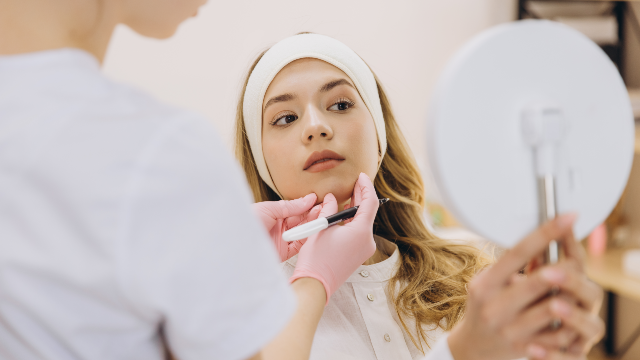
For anything spatial, the plan gets drawn on your face before anything else happens.
Toxnfill Hongdae's filler process includes custom area mapping, with medical staff evaluating facial structure, discussing volume targets, selecting filler brand and density, and establishing a personalized injection design. Alltite Lifting includes custom design mapping tailored to individual facial contours. The MINT thread process includes custom design mapping and personalized consultation before local anesthesia and thread placement. Botulinum toxin treatment areas are assessed and marked before injection.
Watch this step and speak during it. Marking is the last moment at which the plan is fully reversible, and it is the clearest picture you will get of what is actually intended. If the marks do not match your understanding of the conversation, say so before the pen is put down.
The plan: product, device, dose
What comes out of the assessment is a set of specific selections rather than a treatment name.
For fillers, that means the brand and density, the injection design, and the volume. Toxnfill Hongdae's range includes standard domestic options and premium imported ones such as Restylane, JUVÉDERM, and Belotero, and the clinic's own general guidance distinguishes their longevity: roughly six to twelve months for its listed standard fillers, and twelve to twenty-four months for premium imported choices. For botulinum toxin, the selections are product and dose, chosen after evaluation of the target muscles, with Korean, German, and US-origin products available. For energy-based lifting, the selections are device, cartridge, and depth.
Ask for those specifics out loud, and ask for them to be written down. The American Society of Plastic Surgeons describes the consultation as the point at which options, expected outcomes, and suitability are discussed; the specifics are what make that discussion checkable afterwards rather than impressionistic.
Risks, and how they should be presented
A consultation that only describes benefits is incomplete.
Toxnfill Hongdae's own risk framing is specific by treatment family. For energy-based lifting it names temporary redness, swelling, tenderness, or sensitivity. For injectable skin boosters it names redness, swelling, tenderness, bruising, or small injection-site bumps. For fillers it notes that temporary bruising, mild swelling, localized pain, or a foreign-body sensation typically resolve within one to two weeks, and that vascular occlusion or severe inflammation is rare. For botulinum toxin it names temporary redness, swelling, bruising, tenderness, headache, or discomfort, with unwanted muscle weakness a rare possibility depending on the injection site.
You should hear a version of this in the room, tied to the specific treatment planned rather than to the category. You should also hear the limits: the clinic frames results as varying with treatment and individual, which is the correct framing and one worth noticing when it is absent elsewhere.
Anesthesia and the clock
Numbing time is real time, and it changes how long you are in the building.
Toxnfill Hongdae lists topical or ointment anesthesia for several treatments, with roughly twenty to thirty minutes of numbing time for Ultherapy Prime and for filler treatment. Shurink HIFU adds twenty to thirty minutes of numbing cream to a treatment time of fifteen to twenty minutes. Thermage FLX uses topical anesthesia along with vibration and cooling functions for comfort and skin protection. Botulinum toxin injections usually require no anesthesia, though topical numbing may be offered.
If your consultation converts into same-day treatment, ask what the numbing interval adds. A treatment listed at twenty minutes can occupy the better part of an hour once preparation is included.
What follows the consultation, step by step
If treatment goes ahead, the consultation is the first item in a published sequence rather than a separate event, and knowing the rest of the sequence makes the appointment easier to read.
Ultherapy Prime runs consultation, cleansing, topical anesthesia, ultrasound gel, treatment, then issue of a certificate of authenticity. Thermage FLX begins with customized consultation, then cleansing, topical anesthesia, fluid application, treatment, and its own authenticity certificate. Shurink HIFU runs customized consultation, topical anesthetic ointment, ultrasound gel, energy administration, and post-treatment finishing. ONDA Lifting prepares the target area, activates contact cooling through the handpiece to protect the epidermis, then delivers controlled microwave energy into the dermal and fat layers. Alltite Lifting proceeds through cleansing, topical numbing, conductive gel, targeted energy delivery, and soothing post-care. Filler treatment runs a pre-procedure photograph, topical or local anesthesia, custom area mapping, injection, and a post-treatment photograph. Contouring injection treatment is described as three steps: customized consultation, design, then treatment. Laser hair removal runs customized consultation, before-treatment photographs, ointment anesthesia, then the laser itself.
Two things stand out across that list. Consultation appears as step one almost everywhere, which is the clinic's stated position that treatment follows medical consultation rather than preceding it. And several sequences end in documentation — a certificate, a photograph — which is worth knowing so you do not leave before collecting it.
Aftercare is a consultation topic, not a parting note
The instructions that govern your next few days should be discussed while you can still ask about them, not handed over at the door.
They are treatment-specific, and restrictive enough to reshape an itinerary. After a skin booster at Toxnfill Hongdae, the excluded list runs for three to seven days and covers bathhouses, hot bathing, hard exercise, and heavy drinking, with moisturizer and sunscreen advised. After filler, the comparable window stretches to between one and three weeks and adds pressure on the treated site, along with a short antibiotic course taken by mouth. After botulinum toxin, the instruction is to leave the area alone — no rubbing, no firm pressure — and to pause alcohol, bathhouses, and strenuous activity briefly. After energy-based lifting, the standing advice is sun protection and gentle skincare.
Ask which of these applies to your specific plan, and ask what happens if you cannot comply — a long flight, a scheduled event, a bathhouse already booked into your itinerary. A clinician can often adjust timing if the conflict is known in advance and cannot do anything about it once treatment has happened.
Ask, too, what the follow-up route is. The clinic's English-language patient services and contact channel are the mechanism, and confirming how to reach a clinician after you have left the country is a five-second question with a large payoff.
Photographs
Photography is built into several of the clinic's protocols. Its filler sequence includes a pre-procedure photograph and a post-treatment photograph. Its laser hair removal sequence includes pre-treatment photographic documentation as part of the assessment step.
Expect to be photographed, and treat it as useful rather than intrusive: those images are the baseline against which any later question about change is settled. Ask whether you can have copies.
The consultation fee question
Worth raising before you arrive rather than at the desk. For Sofwave Skin Tightening, Toxnfill Hongdae notes that consultation with medical staff is available and that a consultation fee may apply if no procedure is performed that day.
That structure is common in aesthetic practice and is not unreasonable — a consultation consumes clinical time whether or not treatment follows. What matters is knowing the arrangement in advance, particularly if you intend to consult and then think it over. Ask how it works for the specific treatment you are discussing when you arrange the appointment through the clinic's contact page.
How this differs from a US dermatology visit
Several differences are structural rather than qualitative.
The first is scope. The American Academy of Dermatology describes the specialty as covering skin, hair, and nails across medical, surgical, and cosmetic care, all within one physician's remit. A US dermatology appointment may move between those registers in a single visit. A dedicated aesthetic consultation is narrower by design, and a concern that turns out to be medical rather than cosmetic belongs with a physician who can pursue it.
The second is the instrumentation described above, which is more consistently present in Korean aesthetic practice than most American patients expect.
The third is billing structure, since cosmetic treatment is self-funded in both countries but the surrounding expectations differ. The US Centers for Medicare & Medicaid Services describes the good-faith estimate that uninsured and self-pay patients are entitled to receive before scheduled care in the United States. That entitlement is a feature of US law and does not follow you abroad, so the equivalent clarity has to be requested rather than assumed.
What to bring
- A written list of medications, supplements, and allergies
- Dates and product names for previous aesthetic treatments, as far as you know them
- Photographs of your own skin on a good day and a bad day, if the concern fluctuates
- A short written list of your questions, in priority order
- A note of anything you are unwilling to have done, so it is on the record before marking starts
The Agency for Healthcare Research and Quality's patient-question guidance is a reasonable template for the last item: its published list includes asking why a treatment is needed, what the alternatives are, what complications are possible, and how often the clinician has performed the procedure. Those four translate cleanly into an aesthetic consultation.
Deciding on the day, or not
Many patients traveling from abroad consult and treat on the same visit, for the obvious reason. That is workable, but decide in advance whether you are willing to do it, because the pressure of a booked trip is a poor input to a clinical decision.
If you would rather think, say so at the start of the appointment rather than at the end. It changes how the conversation runs, and it gives the clinician the chance to tell you which parts of the plan are time-sensitive and which are not. You can read more about the clinic and its team on its about page before you go in.
The CDC's Yellow Book guidance on care obtained abroad is worth keeping in view here: it advises travelers to discuss planned treatment with their own healthcare professional beforehand. A plan you have already discussed at home is a plan you can accept or decline in the room without improvising.
The Bottom Line
- The appointment follows a consistent five-part shape at Toxnfill Hongdae: intake and history, examination, selection of approach and settings, design mapping, then risks and consent.
- Assessment is often instrumented — digital skin analysis such as Mark-Vu for skin care and peels, real-time ultrasound imaging to eight millimeters for Ultherapy Prime, and skin-thickness and fat-layer assessment for ONDA and Alltite.
- The output should be specific: product brand and volume, or device, cartridge, and depth — not just a treatment name. Ask for it in writing.
- A consultation fee may apply if no procedure is performed on the day for some treatments, so confirm the arrangement when you book rather than at the desk.
Frequently Asked Questions
How long does the consultation itself take?
It varies with what is being planned. A straightforward botulinum toxin discussion is short; a first assessment for lifting or filler contouring takes longer because the plan is spatial and must be mapped. If treatment follows on the same day, add the numbing interval — Toxnfill Hongdae lists roughly twenty to thirty minutes of topical anesthesia for filler and for Ultherapy Prime.
What will I be asked about?
Your skin concerns and goals, medical history, current medications, allergies, and previous cosmetic procedures — this pattern holds across the clinic's treatment families. For botulinum toxin the practitioner also evaluates the target muscles; for fillers and collagen stimulators, the facial structure and the areas to be treated.
Will my skin be analyzed with a device?
For medical skin care and peels, yes: Toxnfill Hongdae performs a tailored evaluation using digital skin analysis tools such as Mark-Vu to identify skin type, moisture levels, and specific concerns. Ultherapy Prime uses real-time ultrasound imaging to assess depth and structures, and ONDA and Alltite assessments include skin thickness and, for ONDA, fat-layer distribution.
Is there a fee if I consult and decide against treatment?
For Sofwave Skin Tightening the clinic notes that a consultation fee may apply where no procedure is performed that day. Ask how it applies to the treatment you are considering when you arrange the appointment, so the arrangement is settled before you arrive.
Can I change my mind after the marking is done?
Yes, and marking is the right moment to raise a concern. It is the clearest representation of the intended plan and the last fully reversible step. The clinic's filler process includes custom area mapping and a personalized injection design specifically so the plan is visible before it is executed.
Should I expect to be photographed?
For several treatments, yes. The clinic's filler protocol includes pre-procedure and post-treatment photographs, and its laser hair removal assessment includes pre-treatment photographic documentation. Ask for copies for your own records.
How is this different from seeing a dermatologist at home?
Scope and structure, mainly. The American Academy of Dermatology frames the specialty broadly — skin, hair, and nails, across medical, surgical, and cosmetic care — and a US visit may cross those categories in one sitting. An aesthetic consultation is narrower, more instrumented, and self-funded — and the good-faith estimate that US law provides to self-pay patients, described by the Centers for Medicare & Medicaid Services, does not travel with you.
This article is for general informational purposes, does not constitute individualized medical advice, and is not a self-diagnosis tool. Consultation practices differ between clinics and change over time. Whether a particular treatment suits you can only be judged by a qualified dermatologist or physician who has examined you in person.
Clinical Notice: Individual treatment outcomes and recovery timelines may vary depending on skin condition and personal physiology. Temporary redness, mild swelling, or bruising may occur after treatment; a pre-procedure physician consultation is always conducted.
More Articles
Continue reading our clinical guides.
Toxnfill Hongdae Dermatologist: Meet Dr. Chang Ye Ji
Medically reviewed by Dr. Chang Ye Ji, MD, Chief Director, Toxnfill Hongdae The lead dermatologist at Toxnfill Hongdae is Dr. Chang Ye Ji, who serves as the branch's Chief Director
Learn More
Korean Dermatology Residency Training: How Doctors Qualify
Medically reviewed by Dr. Chang Ye Ji, MD, Chief Director, Toxnfill Hongdae Korean dermatology residency training follows a sequence that will look broadly familiar to an American
Learn More
In-Person Consultation at a Korean Dermatology Clinic
Medically reviewed by Dr. Chang Ye Ji, MD, Chief Director, Toxnfill Hongdae An in person consultation at a Korea dermatology clinic is a working appointment with a defined shape: h
Learn More