Personalized Medical Care & Dedicated International Patient Concierge

Medical Guide
First Time Botox in Korea: What to Expect, Step by Step
Medically reviewed by Dr. Byun Sung Ho, MD, Director, Toxnfill Hongdae A first time Botox appointment in Korea is mostly assessment and conversation, and only briefly an injection.
Schedule a ConsultationMedically reviewed by Dr. Byun Sung Ho, MD, Director, Toxnfill Hongdae
A first time Botox appointment in Korea is mostly assessment and conversation, and only briefly an injection. Toxnfill Hongdae describes a Botox consultation that reviews your goal, how your muscles move, the anatomy of the area, your medical history, your medications and any earlier procedures, after which the practitioner judges whether treatment and the proposed dose fit you. The injection itself is short. The result is not: the effect builds across the following days, and the first fair look at your outcome arrives around two weeks later. This guide walks a beginner through each of those stages in order.
Botulinum toxin is a prescription drug, not a piece of equipment. StatPearls, published by the National Library of Medicine's NCBI Bookshelf, describes it as a potent neurotoxin produced by the bacterium Clostridium botulinum, in clinical use since the late 1970s, which stops nerve endings from releasing acetylcholine, the signaling chemical that instructs a muscle to tighten. That blockade is reversible. Everything below follows from those two facts: the effect is temporary, and it acts on movement.
What the First Consultation Is Actually For
The purpose of a first consultation is to decide whether and where, not simply to schedule an injection.
Toxnfill Hongdae describes an assessment covering your medical history, your medications, any earlier procedures, the anatomy of the area involved, how much the target muscles move, and the outcome you are asking for. The practitioner then determines whether Botox and the planned dosage suit you. For its pore-focused Botox program, the clinician evaluates skin condition, pore appearance, the treatment area and treatment goals, then sets the area and dose from that. In both cases the sequence is the same: look first, decide second, inject third.
Because you are botulinum-toxin-naive, there is no prior dose to copy and no earlier response to lean on. A first plan is therefore a starting point built from anatomy and stated goals.
What a first-timer can usefully bring
- A written list of every medication and supplement you take. Toxnfill Hongdae advises discussing blood-thinning medicines and supplements with the doctor before treatment.
- Your allergy history, and in particular any known sensitivity to botulinum toxin products.
- Any diagnosed neuromuscular condition, since the clinic names certain neuromuscular disorders among the reasons treatment may not be suitable.
- A note of any recent procedures on the same area, and of any skin infection or active inflammation there. The clinic advises against treating over inflamed or infected areas.
- Photographs of your own face at rest and mid-expression, taken in daylight on your phone. These are for you, not the clinic: they are the only honest baseline you will have when you judge the result later.
- One clear sentence describing what bothers you. "My forehead lines show in photographs" is a workable brief.
Dr. Byun Sung Ho, a Director at Toxnfill Hongdae, lists botulinum toxin, dermal fillers and aesthetic skin treatments among his core areas of practice, with medical education at Busan National University School of Medicine. The clinic offers English-language support and maintains an English website with treatment information and booking sections, so a first consultation does not have to be conducted in Korean.
Why the Clinician Watches Your Face Move
The examination involves movement because the lines that botulinum toxin softens are made by muscles pulling on skin.
StatPearls notes that the muscles of facial expression are unusual: they arise from bone but insert into the dermis, so they move skin rather than skeleton. It identifies which line comes from which muscle — crow's feet from repeated orbicularis oculi use, frown lines from the corrugator supercilii, bunny lines on the sides of the nose from the nasalis, and horizontal forehead lines from sustained frontalis contraction. Asking you to frown, raise your brows and squint is how a clinician reads that map on your face.
The forehead illustrates why the reading matters. In its chapter on the frontalis muscle, StatPearls describes it as the only muscle that raises the eyebrows, working against the procerus, the corrugator supercilii and the orbicularis oculi, which pull the brow down. The balance between that single elevator and those three depressors sets the position and shape of your eyebrows. Weaken the elevator too much while the depressors stay strong, and the brow sits lower than it did.
Individual variation is also larger than most first-timers expect. The same chapter describes four recognized patterns of horizontal forehead lines: full lines running the whole width of the forehead in about 45 percent of people, gull-wing lines with a central dip in about 30 percent, short central lines only in about 10 percent, and lines confined to the outer forehead in about 15 percent. It also reports gross asymmetry between the right and left bellies of the frontalis in around a third of people.
Beginner Botox Areas: Forehead, Glabella and Outer Eyes
The areas most first-timers ask about are also the areas with approved cosmetic use, which is a useful place to start.
StatPearls records the cosmetic indications for botulinum toxin in adults as the temporary improvement of moderate to severe glabellar lines linked to corrugator and procerus activity, lateral canthal lines linked to orbicularis oculi activity, and forehead lines linked to frontalis activity. Toxnfill Hongdae's own list of treatment areas runs from the forehead, glabella and outer eyes through to the jaw, salivary glands and selected muscles of the body, with treatment customized by area and product type.
The glabella — the patch between your eyebrows. StatPearls describes the glabellar complex as a group rather than a single muscle: the procerus, corrugator supercilii, depressor supercilii, the medial fibers of the orbicularis oculi and fibers of the frontalis all converge there. The corrugator pulls the brow inward and downward, producing the vertical lines many people call their elevens. Glabellar lines are often the earliest lines to appear on the upper face, and the glabella was the first region ever treated cosmetically with botulinum toxin type A. It is also variable: researchers have classified five glabellar contraction patterns in European and American populations and six in Asian populations. A separate StatPearls chapter on the corrugator supercilii adds two points that matter here. Injection depth is not uniform — deeper near the muscle's origin, shallower toward its outer end — and the reported position of the corrugator and of the nerve passing through it differs between Asian and White populations, so a technique built for one group should not be assumed to transfer.** The forehead.** Because the frontalis is the sole brow elevator, StatPearls states plainly that the aim of forehead injection is not complete paralysis of the muscle, and describes a dose distributed across the forehead in the range of ten to twenty units as giving satisfactory softening of horizontal lines. It adds two technical points a beginner can reasonably ask about: that a safe zone for frontalis injection sits about two centimeters above the brow, and that the corrugator and procerus should be treated alongside the frontalis. That last point answers a question first-timers often raise — why the doctor proposes treating your frown when you came in talking about your forehead. Treating the elevator without the depressors unbalances the pair.** The outer eyes.** StatPearls notes that the orbicularis oculi sits exceptionally close to the skin surface, with essentially no subcutaneous fat between the muscle fibers and the dermis, and describes it as among the fastest-moving muscles in the body. Injections there are correspondingly shallow and small.
The Appointment Itself
The treatment portion of a first visit is short, and the steps are few.
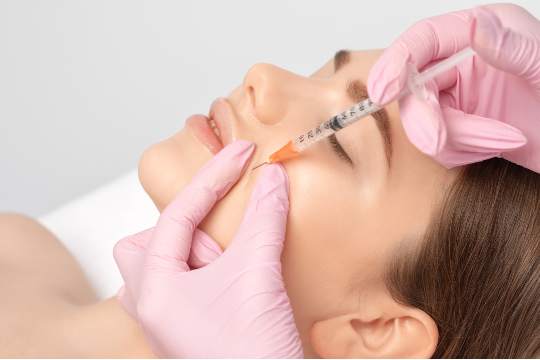
Toxnfill Hongdae describes the sequence as assessing and marking the treatment area, cleansing the skin, and then injecting small amounts of Botox into the selected muscles using a fine needle. The number and placement of injections follow the area and your individual anatomy. The clinic describes general anesthesia as not required, with topical numbing or other comfort measures available depending on the area and your own preference.
On timing, the clinic puts a Botox treatment at roughly 10 to 30 minutes depending on how many areas are treated, and its pore-focused program at about 15 to 20 minutes. Treatment is performed as an outpatient visit with no hospital stay, though total time in the building depends on the consultation and preparation that precede the injection.
How the injection feels
Toxnfill Hongdae describes what most patients experience as brief pinching or stinging from the small injections. For its pore-focused treatment, which uses multiple injection points across the cheek area, it describes mild pinching or stinging during those repeated small injections rather than a single sharp event. Afterwards, the clinic notes that temporary pulling, mild pain or throbbing can occur around the treated area, and that most people return to normal activities quickly.
One fact is worth more here than reassurance. StatPearls states that at recommended doses, botulinum toxin is undetectable in peripheral blood after intramuscular injection using currently available analytical methods. The drug's action is local, and its measurable presence is local too.
The Onset Timeline, and Why Day One Looks Unchanged
Nothing visible happens immediately, and that is the expected course rather than a sign of a problem.
Toxnfill Hongdae describes Botox effects as developing gradually rather than at once, commonly becoming noticeable within several days, with improvement becoming clearer across the following one to two weeks. It describes the result as generally assessed around two weeks after treatment. For its pore-focused program, the clinic describes improvement developing over several days to about two weeks, again with review at roughly the two-week mark.
StatPearls gives a compatible figure from the pharmacology side: botulinum toxin takes approximately two weeks to develop its effect fully, and lasts about three to five months in cosmetic practice. It also notes that cosmetic injections warrant routine review roughly every three to five months.
Put together, a realistic first-timer schedule looks like this:
-Day 0. Injection. Small marks, possible redness or a minor bruise. Your face still moves exactly as it did that morning.
-Days 1 to 3. The first change usually registers here. Toxnfill Hongdae describes effects commonly becoming noticeable within several days.
-Days 4 to 14. The effect deepens. This is where most of the visible difference appears.
-Around week 2. The point at which the result can fairly be judged, per the clinic's own review timing and the roughly two-week onset described in StatPearls.
-Months 3 to 5. Movement gradually returns as the blockade wears off. The clinic describes the effect as temporary and expects repeat treatment once muscle activity has come back.
The practical consequence for a traveler is that you will almost certainly be home before your result is complete. Photograph yourself on the day of treatment and again at two weeks, in the same light, so the comparison is with your baseline rather than your memory of it.
Aftercare for an Injectable Treatment
Aftercare here is about leaving the treated tissue alone rather than recovery in any real sense.
Toxnfill Hongdae's instructions for botulinum toxin treatment are these:
- Do not rub the treated area, and avoid firm pressure on the injection sites immediately after treatment.
- Leave out alcohol temporarily.
- Skip the sauna and jjimjilbang, and skip hot baths.
- Postpone intense exercise.
- Follow whatever specific activity restrictions the practitioner gives you for your particular treatment area.
Normal daily activity resumes quickly. The clinic describes most patients returning to their routine shortly after treatment, with mild redness, swelling or bruising possibly lingering for a few days around the injection points. Where a body muscle has been treated, activities that heavily engage that muscle may need to be limited for longer, and the practitioner will say for how long.
Downtime is described as minimal, which is why a compressed itinerary usually accommodates a first treatment. Travel soon afterward is presented as workable for patients whose recovery follows the expected pattern.
Side Effects: What Is Ordinary and What Should Be Reported
The common effects are minor and local, and worth separating from the rare ones.
Toxnfill Hongdae lists temporary pain, tenderness, swelling, bruising, headache or weakness around the treated area among possible effects, along with redness and small bumps at injection points. It lists asymmetry, unwanted weakness of nearby muscles, and eyelid or brow drooping among the rare risks.
StatPearls characterizes adverse effects as frequently moderate and self-limited, and notes that cosmetic use has been associated with fewer serious effects than therapeutic use, which involves higher doses. It lists bruising, swelling and injection-site pain among the minor effects of aesthetic use, along with flu-like symptoms. Blepharoptosis — drooping of the upper eyelid — and eyebrow ptosis are described as less common and explicitly as injector-dependent, arising when toxin placed in the glabellar muscles disperses into the muscle that lifts the eyelid. Where that happens, the effect is described as lasting up to about three months. StatPearls also notes that complications fall as injection technique improves, and that excessive dilution of the powdered drug can encourage spread into unintended areas.
Two related outcomes are worth naming, because both are technical rather than mysterious. A lowered brow is the predictable result of a weakened frontalis facing dominant depressors. An uneven brow lift, sometimes called a Spock appearance, follows when the inner frontalis is relaxed while the outer part still contracts. Both are matters of distribution, and both pass.
One safety point applies to every botulinum toxin product wherever treatment happens. StatPearls records the boxed warning these products share: on the basis of postmarketing reports, the toxin's effect can reach beyond the injection site, producing symptoms such as swallowing or breathing difficulty, generalized weakness, drooping eyelids, double vision or voice changes, from hours to weeks afterward. Swallowing and breathing difficulty can be serious. Before you leave the clinic, know who to contact and how, and treat any of those symptoms as a reason to seek medical care.
Perfect Symmetry Is Not the Target
Faces are not symmetrical before treatment, and a plan built on that fact reads more naturally than one that ignores it.
StatPearls reports that the lateral extent of the frontalis, where it interlaces with the orbicularis oculi, is asymmetric in about 20 percent of people, and that the right belly of the muscle is on average significantly larger than the left, even though electromyography shows both sides generating the same activity. That is why a plan is drawn on your face rather than copied from a diagram, and why your two eyebrows may not respond identically to identical doses.
Skin and Pore Botox: The Same Drug, a Different Target
Not every botulinum toxin injection aims at an expression line, and one of the clinic's programs is a useful example.
Toxnfill Hongdae describes Skin & Pore Botox as targeting pore appearance and skin surface texture, delivered through multiple injection points, with the cheek region it calls the butterfly zone identified as its pore-focused area. Candidates are described as adults concerned about visible pores, uneven skin texture or excess sebum, and results vary by skin condition, area, dose and individual response.
The practical differences from a first wrinkle treatment are worth knowing:
- The injections are more numerous and more superficial, so the sensation is a series of small pinches spread across an area.
- The treatment runs about 15 to 20 minutes by the clinic's own listing.
- The result timeline is similar, developing over several days to about two weeks.
- Alternatives exist for the same concern. The clinic names radiofrequency microneedling, laser treatments and chemical peels among the options for pore appearance, with the choice depending on pore type and skin condition.
Questions Worth Asking as a Beginner
With no treatment history to draw on, ask about reasoning rather than products.
-Which muscles are you treating, and what does each one do? You should be able to repeat the answer back in plain language before you agree.
-Why that area rather than the one I asked about? The frontalis-and-depressors relationship described above is a legitimate reason to treat more than one site, and it should be explained rather than assumed.
-What are you deliberately leaving able to move? Partial relaxation is a design decision, not a shortfall.
-When should I judge this, and when should I stop expecting change? The answer should sound like the two-week and three-to-five-month figures above.
-What counts as normal in the first week, and what does not? Ask for both lists, and for the contact channel to use after you fly home.
-What would make you decline to treat me today? Infection or significant irritation at the treatment area, a relevant allergy and certain neuromuscular conditions are all reasons the clinic gives for postponing.
Toxnfill Hongdae takes new-patient inquiries through its website, so you can start a first-visit inquiry and set out your goals in writing before you travel. Reading the clinic's own introduction to its directors beforehand is a reasonable way to see who might be treating you.
The Bottom Line
- A first Botox visit is mostly assessment. Toxnfill Hongdae evaluates your goal, muscle activity, anatomy, medical history, medications and previous procedures before deciding on treatment and dose.
- The injection is brief — around 10 to 30 minutes depending on the number of areas — performed with a fine needle, generally without anesthesia, with topical numbing available for comfort.
- Onset is gradual, not immediate. The clinic describes effects becoming noticeable within several days and reviews the result at about two weeks; StatPearls puts full onset at roughly two weeks and cosmetic duration at about three to five months.
- Aftercare is restraint rather than recovery: no rubbing or firm pressure, and a temporary pause on alcohol, saunas and jjimjilbangs, hot baths and intense exercise.
- The upper face is one linked system. The frontalis is the only brow elevator and works against the procerus, corrugator and orbicularis oculi, which is why a first plan usually addresses more than one muscle.
Frequently Asked Questions
How much does a first botulinum toxin injection actually hurt?
Toxnfill Hongdae describes most patients as feeling only brief pinching or stinging from the small injections. A fine needle is used, and the clinic notes that topical numbing or other comfort measures may be offered depending on the area and your preference. Afterwards, temporary pulling, mild pain or throbbing around the treated area can occur.
When will I see my first result, and when is it final?
Toxnfill Hongdae describes initial effects usually developing within a few days, becoming more noticeable across the following one to two weeks, with the outcome generally assessed at around two weeks. StatPearls, published on the National Library of Medicine's NCBI Bookshelf, gives approximately two weeks as the time for the drug's effect to develop fully. If day three looks unchanged, you are on schedule.
Will my face look frozen?
Full immobility is not the technical aim. StatPearls states directly that the goal when injecting the frontalis is to avoid complete paralysis of the muscle, and describes a distributed forehead dose in the range of ten to twenty units as producing satisfactory softening of horizontal lines. Toxnfill Hongdae describes injection areas and amounts as selected according to your facial anatomy and the outcome you want.
How long does a first treatment last?
StatPearls puts the duration of botulinum toxin in cosmetic practice at about three to five months, and notes that cosmetic patients warrant routine review at roughly that interval. Toxnfill Hongdae treats the effect as temporary, expects a repeat once movement has returned, and describes duration as varying with the treatment area, the product, the dose and individual factors.
Can I fly home soon after treatment?
Toxnfill Hongdae describes Botox as having minimal downtime, so a short stay is generally sufficient for international patients, and it describes patients as generally able to travel soon after treatment when there are no unusual symptoms or complications. Booking early in your trip rather than on your last morning leaves room for in-person questions.
I asked about my forehead lines — why is the doctor also treating between my eyebrows?
Because those muscles work against each other. StatPearls describes the frontalis as the only muscle that raises the eyebrows, opposed by the procerus, corrugator supercilii and orbicularis oculi, with the balance between them setting eyebrow position and shape. The same chapter advises injecting the corrugator and procerus when the frontalis is treated. Toxnfill Hongdae lists both the forehead and the glabella among its treatment areas.
What should I avoid on the evening after my first appointment?
Toxnfill Hongdae advises against rubbing or applying firm pressure to the treated area, and advises temporarily avoiding alcohol, sauna and jjimjilbang visits, hot baths and intense exercise. Normal daily activities can generally resume straight away. Any specific activity restriction for your treatment area comes from the practitioner who treated you.
This article is for general informational purposes and does not constitute individualized medical advice, and it is not a self-diagnosis tool. Approved indications, labeling and treatment protocols change over time. Treatment candidacy, injection technique, dose and expected outcomes can only be determined through a consultation with a qualified dermatologist who has examined your face in person.
Clinical Notice: Individual treatment outcomes and recovery timelines may vary depending on skin condition and personal physiology. Temporary redness, mild swelling, or bruising may occur after treatment; a pre-procedure physician consultation is always conducted.
More Articles
Continue reading our clinical guides.
Toxnfill Hongdae Dermatologist: Meet Dr. Chang Ye Ji
Medically reviewed by Dr. Chang Ye Ji, MD, Chief Director, Toxnfill Hongdae The lead dermatologist at Toxnfill Hongdae is Dr. Chang Ye Ji, who serves as the branch's Chief Director
Learn More

Korean Dermatology Residency Training: How Doctors Qualify
Medically reviewed by Dr. Chang Ye Ji, MD, Chief Director, Toxnfill Hongdae Korean dermatology residency training follows a sequence that will look broadly familiar to an American
Learn More
In-Person Consultation at a Korean Dermatology Clinic
Medically reviewed by Dr. Chang Ye Ji, MD, Chief Director, Toxnfill Hongdae An in person consultation at a Korea dermatology clinic is a working appointment with a defined shape: h
Learn More