Personalized Medical Care & Dedicated International Patient Concierge

Medical Guide
Chemical and Natural Peels: Choosing by Recovery Time
Medically reviewed by Dr. Choi Ji Eun, MD, Director, Toxnfill Hongdae Every peel on every clinic menu is the same transaction in different packaging. A solution is applied to the s
Schedule a ConsultationMedically reviewed by Dr. Choi Ji Eun, MD, Director, Toxnfill Hongdae
Every peel on every clinic menu is the same transaction in different packaging. A solution is applied to the skin, it disrupts the surface by a controlled amount, and the skin repairs itself into a smoother, more even state than it started in. The variables that genuinely matter are how much disruption is being bought and how many days of repair it costs.
Which is why the most useful question to bring to a consultation is not which peel is strongest. It is how many days you can actually give this. Answer that honestly and the shortlist writes itself, because how far into the skin a peel reaches and how much recovery it demands are the same fact expressed two ways. Answer it badly, or not at all, and the recovery arrives in the middle of a week you needed your face for.
The Trade Is Recovery for Effect, and It Is Not Negotiable
The American Academy of Dermatology publishes a plain table of what to expect after a peel, sorted by strength, and it is the most clarifying document a prospective patient can read.
For what the Academy calls a refreshing or lunchtime peel, healing takes one to seven days. The skin will be red, and after the redness fades, scaling may develop that lasts three to seven days. At-home care is lotion or cream until the skin heals, followed by daily sunscreen. Makeup is usually possible immediately. No follow-up visit is required, though the Academy notes that three to five such peels may be needed for the result you want, repeated every two to five weeks.
For a medium peel the picture changes shape. Healing takes seven to fourteen days. The Academy is specific that swelling worsens for the first forty-eight hours and that the eyelids may swell, that blisters can form and break open, and that the skin crusts and sheds. At-home care involves daily soaks with ointment, an antiviral medication for ten to fourteen days, and complete avoidance of the sun until healing. Camouflaging makeup becomes possible after five to seven days, and a follow-up visit is required.
For a deep peel the numbers stop resembling a cosmetic appointment. Healing takes fourteen to twenty-one days with the area bandaged, and complete sun avoidance runs three to six months. The Academy adds that a deep peel is performed under general anesthesia in a surgical setting, that recuperation at home runs two to three weeks, and that a person can have only one deep peel.
Read those three descriptions side by side and the category becomes legible. Nobody is really choosing between a gentle peel and a strong one; they are choosing between an afternoon, a fortnight and a month, and the result scales with the choice.
Start From the Calendar, Not From the Menu
Most people arrive having read about a peel by name and ask whether it suits them. The more productive opening is to say how many days you can spend looking visibly treated, whether you have an event, and whether you can return. A clinician who knows that narrows the field immediately, because recovery is the hard constraint and everything else bends around it.
This also reframes what a series is for. Three to five refreshing peels repeated every two to five weeks is an accumulation strategy: small disruptions arriving somewhere a single stronger treatment would reach faster and at the cost of a fortnight. Neither route is superior in the abstract; they are different ways of paying, and the currency is days.
Toxnfill Hongdae's peels sit on the low-disruption side of that choice. The clinic describes makeup as possible the same day, sessions of roughly thirty to sixty minutes, and maintenance repeated at intervals of a few weeks. Its stated side effects are temporary mild redness, minor flaking, slight tightness or transient dryness.
What a Peel Does That Other Treatments Do Not
StatPearls, the clinical reference hosted on the National Library of Medicine's NCBI Bookshelf, describes chemical peeling as applying a chemical substance to cause controlled damage that prompts regeneration and remodeling, improving overall appearance and texture. The operative word is overall. A peel treats a field rather than a target, working on every square millimeter it touches at once. That suits complaints which are diffuse: dullness across the whole face, a generally rough surface, an uneven background tone with no edges you could point at.
The Academy lists what dermatologists use peels for: some types of acne, age spots, blotchy or uneven discoloration, dull complexion, fine lines, freckles, melasma, rough-feeling skin and sun-damaged skin. Toxnfill Hongdae's documented benefits for its own category are in the same register — clearing sebum and dead cells, improving clarity and smoothness, refining the look of pores and raising hydration.
That field effect is genuinely distinct. Energy-based treatments are aimed at a specific absorber; injectables are placed where they are needed. A peel resurfaces indiscriminately, and for a diffuse complaint that is a feature rather than a compromise.
The Complaints for Which a Peel Is the Wrong Instrument
This is the section most peel articles leave out, and the one that saves people money and disappointment.
A mark you can point to that might not be benign. The Academy makes this point bluntly: a dermatologist can tell you whether an age spot is actually an age spot, because seborrheic keratoses, actinic keratoses and skin cancer also become more common with age. Using a cosmetic treatment to fade a skin cancer gives the cancer time to grow and possibly spread, while skin cancer caught early is highly treatable. A single changing spot is a reason to be examined, not a reason to book a peel.** Indented scarring and changes in the shape of the skin.** A peel resurfaces; it does not rebuild contour. A depression left by an old inflammatory lesion is a structural problem, and structural problems belong to a different family of treatments.** Redness and visible vessels.** A solution that loosens surface cells has no particular quarrel with a blood vessel. If the complaint is persistent flushing, a peel is not addressing the thing you dislike.** Pigment sitting deeper than the surface.** Some discoloration is held well below the level a surface treatment reaches, and no amount of exfoliation lifts it out. Which kind you have is an examination question, not a menu question.** Loss of firmness or volume.** A smoother surface does not read as a lifted one.** Melasma approached as an exfoliation problem.** The StatPearls chapter on melasma is explicit that people with the condition should avoid irritant skincare practices, aggressive exfoliation and unmonitored combination bleaching agents, because these can worsen the pigmentation. It names procedure-associated pigment change after peels or lasers as a major risk when technique and photoprotection are not right. A peel can have a role in a melasma plan; it is a poor sole strategy and a dangerous aggressive one.** Anything happening on broken or inflamed skin.** Toxnfill Hongdae lists open facial wounds, active severe skin infection, sunburn and known hypersensitivity to exfoliating acids among the reasons not to proceed. StatPearls adds a history of allergic reaction to a peeling agent, current isotretinoin treatment and body dysmorphic disorder, with a longer set specific to deeper peels including pregnancy or breastfeeding, psoriasis, atopic dermatitis, poor wound healing, uncontrolled diabetes, smoking and a known tendency to keloid formation.
What "Natural" and "Botanical" Actually Mean Here
The word "natural" on a peel does real marketing work and very little chemical work.
Start with the acids. StatPearls records that glycolic acid is derived mainly from fruits, and that the family it belongs to includes glycolic acid from sugar cane, lactic acid from milk and citric acid from citrus fruits. These are plant- and food-derived compounds, and they are also among the most widely used peeling agents in clinical practice, classified in that reference as keratolytics that disrupt the bonds between skin cells and force them to shed. Plant origin tells you where a molecule came from. It says nothing about concentration, pH, or how deep it goes.
Then consider what the word is permitted to mean on a label. The US Food and Drug Administration states that cosmetic labeling does not require agency approval before products go on the market and that the agency does not maintain a list of approved or accepted claims for cosmetics. Claims must be truthful and not misleading, and a product marketed with claims about treating disease or affecting the structure or function of the body is a drug under the law. Because the agency cannot review claims in advance, claims beyond what the law permits do appear. None of that gives "natural" a definition a patient can lean on.
The evidence that plant-derived acids can cause harm is on the record. In July 2024 the FDA warned consumers against purchasing or using certain chemical peel skin products without professional supervision, stating that it has not approved any chemical peel product and that these should only be used under the supervision of a dermatologist or licensed and trained practitioner. It described products containing trichloroacetic acid, glycolic acid, salicylic acid and lactic acid at concentrations too high for safe home use, and issued warning letters over items at strengths such as 90 percent lactic acid and 70 percent glycolic acid. Its stated harms are severe chemical burns, pain, swelling, infection, skin color changes and disfiguring scars, some requiring emergency care.
Milk and sugar cane are the origins of two agents on that list. "Natural" is not a synonym for gentle.
Toxnfill Hongdae's own menu carries treatments in this vocabulary. Its Black Peel is described as a natural chemical peeling treatment derived from fermented black vinegar, and its Aladdin Peeling as a natural exfoliation procedure using micro-needles derived from natural marine ingredients. The second shows the limits of the word: the clinic's own documented recovery for it is that skin peeling begins at three to five days and finishes within five to ten — a real, plan-around-it recovery attached to a treatment whose defining description is that it is natural.
What the Days Afterward Actually Involve
Plan the week, not the appointment.
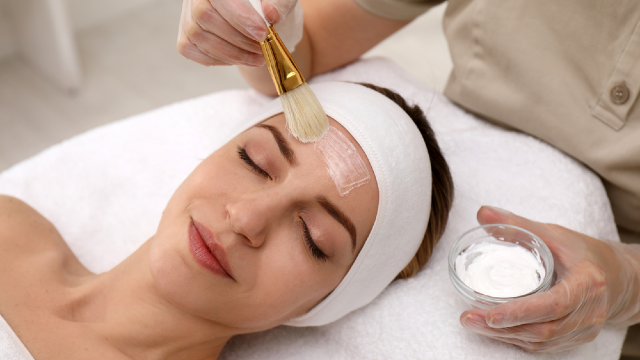
On the day itself, Toxnfill Hongdae describes its peel sessions as running roughly thirty to sixty minutes with no anesthesia required, though mild tingling is possible. Its documented sequence is deep cleansing and skin diagnosis, then the chosen solution or exfoliating device, then soothing care, hydration and light or ultrasound therapy.
In the days that follow, expect the ordinary version of the trade. For its glycolic acid peel the clinic describes zero to minimal downtime with slight flaking or redness possible for one to three days. For the mineral-based exfoliation treatment the flaking arrives later and lasts longer. Its aftercare is consistent and unglamorous: moisturize frequently, maintain strict daily sun protection, and do not pick at flaking skin.
That last instruction is not cosmetic advice. The Academy states that rubbing or scratching treated skin can cause infection, that skin which dries and cracks can scar, and that patients should contact their dermatologist if the skin burns, itches or swells. When serious side effects occur it is often because instructions were not followed, and the failures it names are not protecting the skin from the sun, picking off a scab, applying makeup before the skin has healed, and using a tanning bed.
Why the Same Agent Behaves Differently on Different Skin
Two people can receive the same solution at the same strength for the same length of time and get meaningfully different results. That is why the clinician matters more than the product name.
StatPearls sets out several reasons. The effect of an agent varies with its concentration, with the number of applications during a session, and with the formulation carrying it. It records that people with darker skin tones who also have a history of hypertrophic scar formation are at the highest risk of complications. Its conclusion is the one that matters: patient selection and counseling are crucial to maximizing results and minimizing complications.
Much of the information feeding that selection can only come from the patient. The Academy's preparation guidance asks patients to disclose whether they have ever taken isotretinoin, every other medicine taken recently, whether they frequently get cold sores, whether their skin scars easily, every supplement they take, and every previous cosmetic treatment — with the instruction to omit nothing.
Toxnfill Hongdae documents an assessment consistent with that: a tailored skin evaluation using a digital skin analysis system to identify skin type, moisture levels and specific concerns, with a clinician determining whether a peel is appropriate at all. Its preparation guidance asks patients to avoid aggressive manual exfoliants, retinoids and direct sun exposure for a few days beforehand — an acknowledgment that what you did to your skin last week changes what the peel does this week.
The Academy's own framing is the most direct statement available: the results you see after a chemical peel depend largely on the skill of the person performing it.
The Risk That Changes the Conversation for Skin of Color
This deserves to be stated as what it is: a reason for a specific conversation, not a reason to be turned away.
The Academy's position covers both halves. People who have skin of color can safely have a chemical peel. They should see a dermatologist with expertise in using peels on darker skin tones, because without that knowledge permanent pigment problems can develop.
The mechanism is well described. The StatPearls chapter on postinflammatory hyperpigmentation records that inflammation from skin insults — including dermatologic procedures — triggers mediators that stimulate pigment cells to overproduce, with the pigment transferred into surrounding cells and, in some cases, leaking deeper. It distinguishes the outcomes plainly: pigment held in the upper layers presents as brown discoloration and typically improves substantially within six to twelve months, while pigment that has escaped deeper is engulfed by scavenger cells, appears blue-gray, improves slowly and may be permanent. It states that people with darker skin types are more susceptible because of higher baseline pigment production and more reactive pigment cells, and notes that peels and lasers, if not carefully tailored, may worsen pigmentation in exactly this group.
So the conversation changes rather than ending. It changes which agents are on the table and at what strength, how conservative the first treatment is — since the first treatment is also a test — and how seriously the photoprotection instructions are taken. It also changes how much weight to give the operator's experience: the Academy's own suggested consultation question is how many chemical peels the doctor has performed on people with your skin coloring.
Sun Protection Afterward Is Part of the Treatment
Freshly treated skin has less of its usual surface intact, and the instruction to protect it is not an upsell. StatPearls advises refraining from direct sun exposure during the first several days after a peel, with sunscreen and wide-brimmed hats continuing for several weeks to months.
The practical version is not complicated, but it is stricter than most people's habit. MedlinePlus, from the National Library of Medicine, sets out the everyday measures — cover up, seek shade, use sunscreen properly — and is explicit about avoiding sunlamps and tanning beds altogether. What changes after a peel is not the advice but the margin for error: freshly resurfaced skin has less of its usual defense, so the day you would normally have risked an hour outdoors is the day that costs you. Toxnfill Hongdae's own aftercare asks for strict daily protection at SPF 50 or above.
The Traveler's Version of the Question
If you are having this done in an unfamiliar city and then spending your days walking around it, the calculation is different and worth doing before you book.
The constraint is not the treatment; it is what the days after it require of you. A low-disruption peel with same-day makeup fits a trip without much friction, and Toxnfill Hongdae's documented guidance is that a short stay is generally sufficient for its peel category and that patients can usually fly soon after an uncomplicated treatment. A treatment whose aftercare includes complete sun avoidance until healing, camouflaging makeup only after five to seven days and a required follow-up visit is a different proposition entirely when the itinerary consists of being outdoors in daylight.
Two practical points follow. Decide what the trip is for, and if the days are the point, choose the treatment that does not compete with them. And expect the sun protection instructions to be harder to follow while sightseeing than at home, which argues for planning shade, a brimmed hat and reapplication rather than assuming you will manage.
Questions Worth Asking at the Assessment
Three are worth writing down: how many days will I look visibly treated; is a peel the right family of treatment at all; and is there anything here that should be examined rather than treated cosmetically?
Toxnfill Hongdae takes inquiries through its contact page, and its clinic profile sets out how it describes its treatment categories. The medical team page lists the physicians who carry out the assessment.
The Bottom Line
- Every peel buys effect with recovery time, and the American Academy of Dermatology's healing figures make the exchange rate explicit: one to seven days for a refreshing peel, seven to fourteen for a medium peel, fourteen to twenty-one for a deep peel.
- Choose from how many days you can genuinely give the treatment rather than from which product sounds strongest, because reach and downtime are the same fact described twice.
- A peel treats a diffuse field well and is the wrong instrument for a single suspicious spot, indented scarring, visible vessels, loss of firmness, or melasma approached aggressively.
- "Natural" describes where an ingredient came from, not how strong it is: the FDA has warned about home peel products containing plant-derived acids at concentrations that cause chemical burns and scarring.
- People with skin of color can safely have peels, and the Academy's condition is expertise in darker skin tones, because pigment that escapes deeper after inflammation can be permanent.
Frequently Asked Questions
How do I know which strength of peel I need?
Work backward from your calendar rather than forward from the product list. The American Academy of Dermatology's published healing times run from one to seven days for a refreshing peel through seven to fourteen days for a medium peel to fourteen to twenty-one days for a deep peel. Tell the clinician how many days you can look visibly treated, and the realistic options narrow immediately.
Is a peel described as natural or botanical gentler than a chemical one?
Not by virtue of the description. StatPearls records that glycolic acid is derived mainly from fruits, lactic acid from milk and citric acid from citrus, and these are among the standard peeling agents in clinical use. The FDA states that it does not maintain a list of approved cosmetic claims and does not review labeling before products reach the market. Strength, formulation and contact time determine how a peel behaves, not the origin of the molecule.
Can I have a peel while I am traveling?
It depends entirely on which peel. Toxnfill Hongdae describes its own peel category as having zero downtime with makeup possible the same day, and its documented guidance is that a short stay is generally sufficient and that patients can usually fly soon afterward. A treatment requiring complete sun avoidance until healing is a poor match for days spent outdoors.
What should I not use a peel for?
For any single spot that is changing, because the Academy warns that seborrheic keratoses, actinic keratoses and skin cancer all become more common with age, and fading a skin cancer cosmetically gives it time to grow. Also for indented scarring, for visible blood vessels, and for loss of firmness. In each case a different family of treatment is indicated.
I have a deeper skin tone. Should I avoid peels?
No, but the conversation changes. The American Academy of Dermatology states that people with skin of color can safely have a chemical peel and should see a dermatologist with expertise in treating darker skin tones, because without that expertise permanent pigment problems can develop. StatPearls notes that pigment which escapes deeper after inflammation appears blue-gray and may be permanent. Conservative choices and strict sun protection are the practical response.
How soon can I go out in the sun afterward?
Later than most people expect. StatPearls advises avoiding direct sun for the first several days and continuing sunscreen and a wide-brimmed hat for weeks to months — a window measured in weeks rather than in the day or two most travelers budget for. The clinic's own aftercare asks for daily protection at SPF 50 or above.
This article is for general informational purposes, does not constitute individualized medical advice, and is not a self-diagnosis tool. Peel formulations, product availability and treatment protocols change over time. Only a qualified dermatologist or physician who has examined your skin in person can determine whether a peel is appropriate for you and at what strength.
Clinical Notice: Individual treatment outcomes and recovery timelines may vary depending on skin condition and personal physiology. Temporary redness, mild swelling, or bruising may occur after treatment; a pre-procedure physician consultation is always conducted.
More Articles
Continue reading our clinical guides.
Toxnfill Hongdae Dermatologist: Meet Dr. Chang Ye Ji
Medically reviewed by Dr. Chang Ye Ji, MD, Chief Director, Toxnfill Hongdae The lead dermatologist at Toxnfill Hongdae is Dr. Chang Ye Ji, who serves as the branch's Chief Director
Learn More
Korean Dermatology Residency Training: How Doctors Qualify
Medically reviewed by Dr. Chang Ye Ji, MD, Chief Director, Toxnfill Hongdae Korean dermatology residency training follows a sequence that will look broadly familiar to an American
Learn More
In-Person Consultation at a Korean Dermatology Clinic
Medically reviewed by Dr. Chang Ye Ji, MD, Chief Director, Toxnfill Hongdae An in person consultation at a Korea dermatology clinic is a working appointment with a defined shape: h
Learn More